Showing posts with label Sector Analysis. Show all posts

Jan 4, 2018

Malaysia 1H18 Outlook - Regaining Some Lustre In 1Q18

,

Malaysian equities should trend higher in 1Q18, fulfilling the historically good correlation between ringgit deposit growth and market performance. However, we continue to expect a duller performance post GE14, which is widely expected in Mar-Apr 18. We advocate a trading-oriented, mid- to large-cap-biased investment strategy for 1Q18, with a focus on mega infrastructure, E&E, tourism-related and selective GE14 plays.

WHAT’S NEW
Sparkles to broaden in 1Q18. We continue to expect the broader Malaysian equities to market to trend up in 1Q18 (although there could be a temporary trend reversal in the FBMKLCI following the last few trading days’ hefty 3.0% window-dressing gains), amid the anticipation of GE14, firm domestic economic indicators, and ample global/domestic trading liquidity. Improved domestic liquidity is well proxied by the growth in ringgit- deposit growth since Sep 17 (+4.5% vs +0.5% for 2016).
End-18 FBMKLCI at 1,860. While we continue to peg the market at an above-historical mean PE multiple, we assume the premium will ease in 2018 (+0.6SD vs 2017’s expected +0.7SD). Our bottom-up FBMKLCI target is 1,860.
Strategy and investment themes. We advocate focusing on beta stocks in 1Q18 before turning defensive thereafter. Market conditions still generally favour mid-caps, which continue to sustain superior earnings growth. Multi-year investment themes include: a) mega infrastructure (benefitting the construction and building material sectors; large-cap construction companies clawing back 2017’s losses), and b) electronics and electrical (E&E), followed by the situational GE14 and tourism-related picks.

ACTION
OVERWEIGHT building materials, construction, E&E, gaming, technology and utilities The construction and building material sectors will be supported by more contract awards and implementation of mega projects, with construction activities perhaps only reaching the peak in 2019. The defensive and high-yielding utilities should outperform post GE14. However, UNDERWEIGHT cyclical sectors like automobile and plantation.
Our top picks include large-caps Bumi Armada , CIMB Group , Gamuda , Genting Malaysia , and Tenaga Nasional , and small/mid-caps Ann Joo Resources , Choo Bee Metal Industries , Gabungan AQRS , Globetronics Technology , Hume Industries , Serba Dinamik, Tune Protect , VS Industry and Yong Tai . Other notable picks include Magnum and YTL Power , while potentially interesting election trading plays include FGV and MRCB. However, SELL the pricey Hartalega Holdings (unsustainably stretched valuations) and UMW Holdings.

malaysia 2018 top stock picks

ESSENTIALS
Improving domestic liquidity to help lift equities. The growth recovery of the ringgit deposit growth (+5.8% in Nov 17 from 2016’s +0.5%), an important indicator of domestic liquidity, should eventually lift equities – historically the FBMKLCI is positively correlated to ringgit deposits (0.85 correlation in the past 10 years). Foreign equity fund flows have reversed in December (RM860.3m) from September’s year low of RM737.3m net outflow.
Near-term positives ahead of GE14: a) the FBMKLCI has generally yielded positive returns in the three-month periods up to the past election polling dates, b) robust headline economic indicators (refer to RHS table) which support the ringgit and investment sentiment, and c) minimal risk in a portfolio sell-down of Malaysian bonds in 2018, given the more moderate maturity schedule vs that in 2017.
However, investment sentiment may turn cautious after GE14, reflecting continuing political uncertainties (which could lead to policy vagaries that affect corporate profits), and lack of domestic consumption growth sparks despite firm headline economic growth indicators. Corporate earnings could be revisiting the downgrade phase, albeit at milder magnitudes compared to the 2013-16 period (where growth was almost non-existent). Finally, Malaysia’s regional appeal remains mediocre, based on the expected PE-to- corporate earnings growth valuation matrix (see RHS), and taking note of the World Bank’s projection for Malaysia’s GDP growth to ease by 0.2ppt to 4.8% in 2019, slightly weaker than that of Thailand (-0.1ppt) and in contrast to the sustained GDP growth of neighbouring Indonesia, the Philippines and Vietnam.

malaysia particpated event

MAJOR KEY INVESTMENT THEMES & FEATURED BENEFICIARIES
Company& Catalyst
(A) MEGA INFRASTRUCTURE
Ann Joo Resources
Substantially stronger 4Q17 earnings, coupled with the rise in the latest published domestic steel price. Significant rollout of mega projects by mid-18.

Gabungan AQRS
Potential contract wins in 1Q18 from ECRL and Sabah Pan Borneo Highway worth >RM1b.

Gamuda
Clinching a mega project subcontract award (ECRL, MRT3) will positively surprise amid market skepticism.

Hume Industries
Cement prices should firm up significantly in 2018 as mega projects reach high construction activity levels.

(B) E&E TREND RIDERS
Globetronics
Earnings doubling in 2018; further upside on potential commercialization of sensors under development.

Inari Amertron Good visibility in doubling revenues in 3 years, driven by RF packaging segment and Broadcom’s clientele.

VS Industry High growth visibility and potential contract wins to fill up capacities at its new plant (commencing mid-18).

(C) GE-14
FGV
Improved earnings via cost rationalisation could be another positive.

MRCB
Potential sale of EDL will significantly strengthen balance sheet and lift earnings outlook. Has historically traded up to +2SD during GE periods.

(D) TOURISM-RELATED
Genting Malaysia
Normalisation of luck factor post 3Q17, opening of 20th Century Fox theme park by end-18.

Tune Protect
Strong turnaround story with relatively attractive valuations.

Yong Tai
Opening of Impression theatre in Mar 18.

(E) SELECTED CORPORATE DEALS
Magnum
Monetisation via potential listing of 6.3%-owned U-Mobile allows restoration of generous dividend payout.

Tropicana
Potential monetisation of various properties which collectively account for >30% of market cap.

source UOBKayHian – 02/01/2018

Aug 14, 2017

Malaysia - Steel Stocks and Sector

,
Steel- Maintain MARKET WEIGHT. Maintain HOLD for Ann Joo Resources. Prefer deep-value stock – Choo Bee Metal Industries. Potential beneficiary of various highway projects – Prestar Resources.
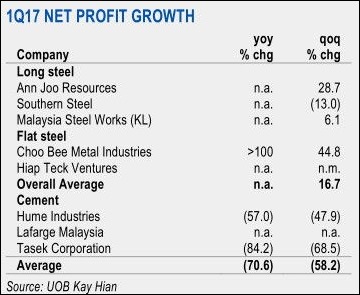
Local steel prices rebounded in Jul 17, echoing China’s steel price movement driven by capacity cuts as well as expectations of increased local demand. We believe that the improvement in ASP should be sustainable moving into 4Q17 as we expect steel demand to improve on mega infrastructure projects. Hence, 2H17 earnings could surprise on the upside after an unexciting 2Q17. Maintain MARKET WEIGHT.
steel stocks growthWHAT’S NEW
Steel prices rebounded in Jul 17. Based on the Ministry of International Trade and Industry (MITI) statistics, domestic steel bar prices for Jul 17 rebounded by 17.4% yoy and 7.8% mom to RM2,178/MT, mainly reflecting the surge in China steel prices. Although Jul 17 prices are still lower than 1Q17 prices (1Q17: RM2,233/MT), we believe that the mom surge will provide for a sector-wide earnings excitement. We also noticed that the price differential between local and China imported billets had widened by 2ppt in July, In Jun 17, China imported billets which were traded at a 20% premium which expanded to 23% in Jul 17.
China’s steel production in Jun 17 at an all-time high. Chinese millers have increased output to an all-time high since Mar 17. China’s steel production was still high in May (- 0.7% mom, +2.5% yoy). We understand that Chinese millers continued to ramp up production as the industry is still reporting healthy margins.
Expect strong earnings growth in 3Q17. Although 2Q17 is expected to have been unexciting (due to weak demand and soft steel prices), we believe that earnings in 3Q17 will surprise on the upside should ASP be sustainable. In addition, we expect steel demand to show a gradual recovery mainly starting from 3Q17 on the commencement of mega infrastructure projects such as MRT 2, LRT 3 and the ECRL.
MALAYSIA MEGA PROJECT ROLLOUTmalaysia mega projects roolout
ACTION
Maintain MARKET WEIGHT. Despite a brighter sector outlook, we believe that the steel companies are already trading within a fair trading range, but prudent capital management could lift valuations. We like steel companies that have prudent capital management, particularly Ann Joo and Choo Bee which had dividend payout ratios of 45% and 43% respectively in their previous financial years. We also believe these companies could declare a bonus share issue ahead of changes to The Company Act 2016 which will abolish the concept of par value.
Maintain HOLD for Ann Joo Resources (AJR MK/HOLD/RM3.11/Target: RM3.30). Although we have a HOLD recommendation, we believe that share price for Ann Joo could be lifted from effective capital management. Ann Joo has a dividend policy of up to a 60% dividend payout ratio subject to future capital requirement. In 2016, Ann Joo distributed 45% of its earnings to shareholders which translates into a dividend yield of 4.8%. Entry price: RM3.00
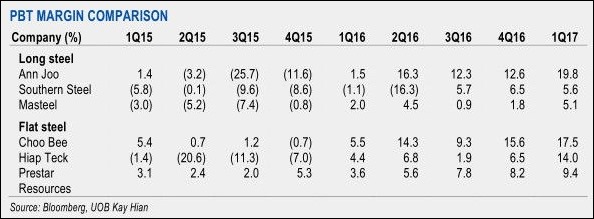
Prefer deep-value stock – Choo Bee Metal Industries (CBEE MK/NOT RATED /RM1.97). Choo Bee could be a proxy to sustainable growth in the flat steel segment. We also like its prudent capital management as it has a 43% dividend payout ratio for 2016 which translated into dividend yield of 4.6%. It is also a net cash company with cash level representing 19% of its market cap. It is currently trades at 6.4x 12-months trailing PE.
Potential beneficiary of various highway projects – Prestar Resources Bhd (PRST MK/NOT RATED /RM1.25). Prestar could benefit from various highway projects where it has 50% market share in supplying guardrail for major highways in Malaysia. Currently, it is trading at 7.3x 12TTM PE and dividend yield of 1.6%. Traditionally, it has been rewarding shareholders with a 20% dividend payout ratio.
steel socks comparison
ESSENTIALS
Local steel prices rebounded in Jul 17. According to MITI’s website, ASP for local steel bars rebounded by 17.4% yoy and 7.8% mom to RM2,178/MT. The strong rebound followed
the soft decline in Jun 17 prices (-2.5% mom) and is in sync with the surge in China steel prices which reached an all-time high since 2013. We also understand ASP for local flat steel products had also picked up in early-Aug 17, after flat growth in Jul 17. We believe that the increase in ASP should be sustainable moving into 2H17 as the price differential between local and China imported billets widened by 3ppt mom in Jul 17. In Jun 17, China imported billets which were traded at a 20% premium which expanded to 23% in Jul 17. The sustainaibility of local steel ASP will be supported by improved demand by 2H17, largely from various mega projects such as MRT2, LRT 3 as well as the east coast rail link (ECRL).
• China steel production at all time high. Steel production in China in the month of June recorded an all-time high 73.2m MT, up by 1.3% mom and 5.4% yoy. To recap, steel production jumped significantly due to reportedly healthy margins which encouraged Chinese millers to increase output. It is worth to note that China’s steel industry made a US$9.8b loss in 2015 but turned around in 2016 with a US$5.1b net profit. In addition, we also attribute the escalation in steel production in China to the closure of induction furnace mills (IF) in China. We gathered that the IF closures are expected to have a fundamental impact on the China steel industry as it could have resulted in a 60m-70m MT cut in production output as of end- Jun 17 (approximately 25-30% of China’s rebar production). Note that the demolition of IF mill is an add-on to China’s initial plan to reduce domestic steel production capacity by 100-150m MT within five years. Products of IF mills are highly criticised for not being environmental friendly (during production process); IF mills do not remove the impurities from scrap, which leads to the production of substandard steel products.
malaysia steel stocks
Sluggish 2Q17 earnings but 3Q17 should see a positive surprise. We reiterate our views that for long steel products, we might see a milder earnings growth in 2Q17 due to softer domestic ASP and persistently weak demand for steel products. To recap, domestic steel bar prices dropped 2.5% mom and 2.3% yoy to RM2,020/MT in Jun 17 while steel bar ASP for 2Q17 dropped 7.1% qoq and 4.0% yoy to RM2,075/MT. However, earnings could surprise on the upside in 3Q17 given the strong rebound in steel prices coupled with a gradual improvement in steel demand. On the other hand, for flat steel products, earnings in 2Q17 could be sustained as prices of hot-rolled coil have fallen 13.9% qoq to Rmb3,223.10/tonne. To recap, average domestic ASP for flat steel increased 30.0% qoq to RM3,000/MT in 1Q17 and subsequently declined by 6.7% to RM2,800/MT in 2Q17.
Prestar Resources as proxy to various highway projects. We recently met with flat steel producer, Prestar Resources Bhd. The company basically operates with two main divisions – a steel processing unit (ie coil centre and steel pipes) as well as a product manufacturing unit (ie material handling equipment and road furniture). We think that Prestar Resources could benefit from mega highway projects as it is the largest guardrail manufacturer in Malaysia with an estimated 50% market share. Prestar Resources also has a proven track record as it previously supplied guardrail for a few notable projects such as the Sepang F1 Race Track, Kesas Highway and East Coast Highway. The company does not have a dividend policy but traditionally has been rewarding shareholders with a 20% dividend payout ratio
source: UOBKayHian – 14/08/2017

Jul 25, 2017

Construction Sector – Malaysia

, ,

Railway-related Jobs To Dominate In 2H17

We expect construction job awards to gain momentum in 2H17 after the lull period in 1H17 due to seasonal factors. In the near term, key events to look out for include: a) awards for the RM9b LRT3, b) groundbreaking of the RM55b ECRL, and c) tabling of the pre-election Budget 2018 in October. We prefer infrastructure construction beneficiaries, including Ekovest, Gamuda and IJM Corporation. We also downgrade Kerjaya Prospek post the share-price rally. Maintain OVERWEIGHT.

WHAT’S NEW
UOBKH’s construction universe outperformed FBMKLCI. Ytd, our construction universe recorded 25.7% growth against the FBMKLCI’s 7.2%. The key performers in the sector include Kerjaya Prospek, Ekovest and Sunway Construction. Kerjaya continues to be on an uptrend given its continuously strong earnings growth that is supported by commendable margins.
Ample re-rating catalysts. First, we believe the Economic Transformation Programme (ETP) would continue to support newsflow momentum and contract awards in the short to medium term. Second, most of the companies under our coverage still have sizeable orderbooks that can sustain earnings going forward. We expect newsflow for a few notable mega projects to excite the sector, such as: a) groundbreaking of the ECRL, b) awards for the RM9b LRT3 job, and c) subcontracting works for the Gemas-JB double tracking job. Cumulatively, these three projects could provide the sector with at least RM70b in construction jobs.

ACTION
Maintain OVERWEIGHT; prefer beneficiaries of infrastructure spending. Companies with a good track record in earnings delivery and strong orderbook replenishment are our preferred picks. These include Ekovest (BUY/Target: RM1.55), Gamuda (BUY/Target: RM6.00) and IJM Corporation (BUY/Target: RM3.95). From a risk-reward perspective, we think Ekovest would outperform in the near term, with its key catalyst being the signing of its DUKE2A concession agreement by year’s end. Gamuda’s catalyst would be further contract wins, which would support its multi-year earnings growth target. For East Coast plays, both IJM Corp (BUY/Target: RM3.95) and Gabungan AQRS (NOT RATED), have significant business exposure in the region, particularly in construction and infrastructure (IJM’s Kuantan Port). We like Gabungan AQRS for its turnaround story, where its construction orderbook is at its all-time high with margins expected to be significantly above the historical record.
Take profit on Kerjaya Prospek post 66.4% returns ytd. We downgrade Kerjaya Prospek to HOLD with an unchanged target price of RM3.69, based on 14x 2018F PE. At current levels, we think the market has priced in the growth potential and anticipated contract wins, which may be forthcoming in the near term. Nevertheless, there could be potential upside to our fair value should the company secure more than RM1b in new orders this year (ytd wins at RM380m). Since our initiation back in Jan 16, Kerjaya’s share price has

malaysia top construction stocks

IMPACT
RM12.9b worth of jobs awarded in 1Q17, more to come in 2H17. To recap, 2016 was a strong year in terms of new job orders, which topped RM176b, driven by the rollout of the MRT Line 2 and Pan Borneo Highway contracts. According to the Construction Industry Development Board (CIDB), total job orders in 1Q17 totalled RM12.9b, driven by the private sector. Historically, job orders tend to be seasonally stronger in 2H due to festivities in the early part of the year.
Pre-election budget tabling should provide further catalysts for the sector. The tabling of Budget 2018, which would be the last budget before the general elections, will take place on 27 Oct 17. Quoting the Prime Minister, the upcoming budget will continue to have “people-centric” projects, which would include the development of good public transportation systems, signalling that the spending on infrastructure projects is expected to continue in the medium term.
Railway-related projects to take the limelight. For the next 3-4 years, railway jobs would continue to dominate the sector’s growth. This would be driven by LRT3, ECRL, HSR and potentially MRT Line 3. In the near term, the key events to look out for include the awarding of the RM9b LRT3 project (possibly in the next 2-3 months), groundbreaking of the ECRL (expected in early-August) and the opening of the tender for the AssetCo for the HSR (expected by this year-end).
● Enough jobs to sustain earnings for next 3-4 years. These mega infrastructure contracts are large enough to support earnings growth in the sector for at least another 3- 4 years. Also, most of the key companies in our universe still have ample orderbooks, which can still sustain earnings should the awarding of these projects be delayed. We expect construction companies under our coverage to report market-weighted average EPS growth of 15.2% in FY17-18, underpinned by healthy construction books. So far, outstanding orderbooks for companies stand at healthy levels of RM2.5b-13.2b each, implying 2.6-14.0x of their respective last financial-year revenues.

status of malaysia infrastructure
SECTOR CATALYSTS
● Contract awards for major infrastructure projects.

RISKS
● Key risks include: a) potential cut in government spending, and b) delay of project surged 114.8%.

source: UOBKayhian – 25/07/2017

Jan 23, 2017

Automobile – Malaysia (UNDERWEIGHT)

,

malaysia car market share

WHAT’S NEW 
Lacklustre finish. Auto sales in December rose 32% mom but declined 6.6% yoy to 64,822 units. The strong mom increase was expected due to the year-end promotions and discounts given by carmakers. The yoy decline was due to a high base in Dec 16 as consumers brought forward their purchases ahead of price hikes effective 1 Jan 16. MAA expects Jan 17 sales volume to be lower than Dec 16’s, given that: a) heavy discounts and promotions by carmakers resulted in many sales concluded in Dec 16, and b) January is a short working month due to the Lunar New Year festival. Overall, 2016 TIV performance declined 13% yoy to 580,240 units, making up 102% of our TIV forecast. 

● National segment sales volume for December rose 38.7% mom, whereby Perodua’s strong 59.4% mom increase in sales volume mitigated a 1.5% mom decline in Proton’s sales volume. Perodua’s strong mom performance may be attributed to its first sedan, Bezza which was launched in mid-Jul 16. On a 12M16 cumulative basis, Perodua’s sales volume was up 18.5% yoy to 207,110 units, while Proton’s sales volume shed 16.8% yoy to 72,290 units. Going into 2017, Perodua aims to sell 202,000 units of vehicles and is also aiming for a slightly
lower market share of 34% (2016: 35.7%). 

● The non-national vehicle segment sales volume rise 38.7% mom and 5.1% yoy to 32,375 units. All major Japanese marques (except Mazda) saw mom increases:
a) Toyota’s sales volume rose 15% mom but down 44% yoy to 7,347 units. 12M16 sales volume declined 10.3% yoy to 63,757 units. The significant yoy decline was due to front-loading by consumers in anticipation of price hikes by Toyota effective 1 Jan 16. The improved
performance in the last two months of 2016 can be attributed to its all-new Vios, which was launched in early-October. It recently launched the all-new Innova MPV in Dec 16 priced between RM109,000 to RM126,000.
b) Honda sales volume rose 28.7% mom and 6.6% yoy to 11,461 units. 12M16 sales volume increased by 22.6% yoy to 91,830 units, surpassing that of Proton’s which stood at 72,290 units. It recently launched a new CKD seven-seat SUV, BR-V priced at RM85,800 – RM92,800 that comes with free service interval package.
c) Nissan’s sales volume rose 57.5% mom but declined 5.3% yoy to 4,804 units. 12M16 sales volume rose 5.8% to 40,706 units.
d) Mazda’s sales volume declined 24.8% mom and 57.2% yoy to 603 units, which may be due to lack of new models and fewer promotions and discounts offered as compared with its Japanese peers. 12M16 sales volume rose 5.8 % yoy.

Peer Comparison:automobile stocks compared
COMMENT
● Maintain 2017 TIV forecast of 580,000 units (flat yoy). Although we foresee a strong pipeline of new models and continuous aggressive discounting and promotions in 2017, we have yet to see a strong recovery in consumer sentiment, particularly purchases on big-ticket items, against the backdrop of subdued macroeconomic environment. MAA has set its 2017 TIV forecast at 590,000 units.
● Maintain UNDERWEIGHT on the sector, as we expect operating environment to remain challenging for the rest of 2016. Sales volume will remain depressed due to soft consumer spending. More aggressive promotions driven by stiff competition coupled with high input
costs due to the prolonged ringgit weakness will continue to crimp margins. Despite the demerger from its loss-making 55.7%-owned listed UMW O&G, we remain negative on UMW Holdings as all of its major divisions are operating in challenging environments coupled
with many non-performing non-core assets.
Yield play on Bermaz Auto. Despite the softness in its 2QFY17 results, Bermaz Auto’s earnings remained more resilient than its listed auto peers’ due to its low base and zero debt position. We see BJ Auto as a yield play for now with a yield of 6.4% for FY18 (based on
an estimated 80% dividend payout). However, we note that there are downside risks to our earnings forecasts on weaker-than-expected consumer sentiment and sharp appreciation of the yen against the ringgit.

source: UOBKayHian Research 20/1/2017

Jan 3, 2017

Malaysia Strategy - 2017: A year of two halves

, ,

■ Stronger-than-expected headwinds drag the KLCI lower in 2016, the third
■ consecutive year of declines.  We predict a challenging 1H17 for the market, followed by a stronger 2H17.
■ Top 1H17 themes are strong US$ play, pump priming and small-mid cap scheme. 
■ Preferred big cap picks for 2017 are Tenaga Nasional, Sime Darby and IJM Corp.
■ We maintain our KLCI target of 1,820 pts, based on 16x forward P/E.

FBM KLCI’s 2016 Main Events:klci main event 2016
What went wrong and right for us in 2016

We had predicted Malaysia would face numerous headwinds in 2016, including slower economic growth and an uncertain external environment. As expected, 2016 was less volatile compared to 2015. However, the headwinds (weaker corporate earnings, strong US$ and slower growth) turned out to be stronger than expected. These, coupled with two unexpected global events (Brexit and Trump’s victory), resulted in a YTD KLCI underperforming our expectations and declining for the third consecutive year in 2016.

2017 could be a year of two halves
We are projecting a challenging 1H17 as we expect consumer spending growth to remain weak ahead of the general elections (GE14). This, coupled with the 4% YTD fall in RM vs. US$ as well as uncertain global policies, could negatively affect sentiment and foreign investment. We expect some of the uncertainties hanging over the market to clear up in 2H17. Our predictions are premised on M&A activities picking up, higher commodity prices flowing through to the economy, a potential post-GE14 relief rally, and the ringgit rising towards its fair value of RM4.10/US$1.

Seven key themes for 2017
We have identified seven themes for 2017: 1) beneficiaries of US$ strength – rubber gloves and agribusiness companies; (2) pump priming and China investments – construction and infrastructure; (3) dividend yield play – utilities and banks; (4) tourism play – airlines and gaming; (5) GLC transformation – conglomerate; (6) small-mid cap research fund and scheme – small cap; (7) GE14 plays – GLC stocks.

Our top sector picks
Our top sector picks are utilities, construction and small caps. In line with our cautious view on the market for 1H17, we chose utilities for its defensive earnings, construction for potential jobs rollout and award of projects ahead of GE14, and small caps as potential beneficiaries of the launch of the small-mid cap research scheme.

Preferred stocks
Our top big cap picks are Tenaga Nasional for utilities exposure, IJM Corp for the construction sector, and Sime Darby for plantation and PNB transformation. Our top 3 smaller caps are MyEG for the foreign workers permit renewal windfall from the amnesty programme, Karex for its strong market positioning and US$ play, and Sasbadi for its defensive business with strong projected earnings growth from iL-Ace.

Maintain 1,820 KLCI target for end-2017
We reiterate our end-2017 KLCI target of 1,820 pts based on 16x P/E, which is in line with its three-year moving average. We believe the target is achievable as most of the bad news have been priced, in our view, judging from the low foreign shareholdings and the three consecutive years of declines. We project that market earnings will rebound by 10% in 2017.
 
 source: CIMB Research Dec 21

Dec 1, 2016

Banking Sector - 5 Preferred Banks

, ,
Banks cutting loan growth projection
malaysia top banks■ Gross impaired loan ratio remained stable at 1.65% in Sep-Oct 16.
■ Loan growth recovered from 4.2% yoy in Sep 16 to 4.5% yoy in Oct 16.
■ We lower our projected loan growth for 2016 from 6-7% to 5.6% and introduce our
loan growth forecast of 5-6% for 2017.
■ Loan application rebounded strongly with a mom growth of 14.4% in Oct 16.
■ Stay Overweight on banks given the attractive valuations and better prospects in
2017.

Preference for the sector.
Stock-wise, we prefer the following banks for exposure to the sector:

BIMB Holdings – BIMB Holdings is our top pick among Malaysian banks as it will be the only beneficiary of EPF’s Simpanan Shariah, to be implemented in 2017 and would increase the inflow of Islamic funds. BIMB is the only listed pure Islamic bank in Malaysia.

The qualities of the stock are reflected by: (1) its unrivalled loan growth, (2) one of the best ROEs in the sector, (3) strong asset quality – one of the lowest gross impaired loan ratios among local banks, and (4) swift expansion of non-fund based income, primarily theTakaful income.

RHB Bank – RHB Bank is an Add in our books given the potential re-rating catalysts of: (1) benefits from the implementation of its IGNITE 17 transformation programme, (2) attractive valuation, (3) cost savings from its career transition scheme materialising from FY16 onwards, (4) gains in market share by its investment banking unit, and (5) the drive for regional expansion in the longer term.

Maybank – We like Maybank for its size and well-diversified business portfolio. In Malaysia, it is ranked among the top three in almost all the key market segments, including trade finance, credit cards, investment banking and Islamic banking. Its geographical diversification, with exposure to underpenetrated markets, such as Indonesia and the Philippines, also helps to support its earnings growth in the longer term. The potential re-rating catalysts for the stock are: (1) benefits from the regionalisation of its businesses in various countries, (2) the recovery in earnings contribution from its Indonesia operations, and (3) potential regional expansion of its Islamic banking and insurance businesses in the longer term.

■  AMMB Holdings – We reiterate our Add recommendation on AMMB Holdings as we expect EPS growth to turn around from a 25.8% decline in FY3/16 to an increase of 3.3% in FY3/17. Other potential re-rating catalysts for the stock include: (1) attractive valuations (CY17F P/E of 9x and P/BV of 0.8x), and (2) enticing dividend yields of 4-5% in CY17F.

Affin Holdings – We still rate Affin an Add given its attractive valuations with CY17F P/E of 7.7x and P/BV of 0.5x. In addition, we are positive on the implementation of its Affinity transformation programme, which would yield positive results in the areas of fee income generation, operating efficiency as well as margins.
Management also has aggressive targets of increasing the bank’s ROE by 2-3% pts by 2020 and doubling the bank’s 2015 operating revenue by 2020. This reflects management’s commitments to significantly improve the financial performance of Affin Bank and also its positive views on the impact from the transformation programme.

source: CIMB Research – 01/12/16

Nov 30, 2016

Top Stocks Picks (By Sector) Based On Consensus Target Price

, ,
CONSENSUS TARGET PRICE
Userguide: To complement the top down approach, Mercury Securities will be compiling the top three underpriced equities of the respective sectors based on the consensus target price premium over the current price on a weekly basis.consensus target priceFINANCE
Hong Leong Financial Group Bhd 14.96 (Closing Price)  17.50 (Target Price)  17.0% (Premium)

CIMB Group Holdings Bhd
4.66 (Closing Price)  5.07 (Target Price)  8.8% (Premium)

AMMB Holdings Bhd
4.19 (Closing Price)  4.45 (Target Price)  6.2% (Premium)

PROPERTY
Eco World Development Group Bhd

1.36 (Closing Price)  1.64 (Target Price)  21.0% (Premium)

LBS Bina Group Bhd
1.71 (Closing Price)  2.08 (Target Price)  21.6% (Premium)

Mah Sing Group Bhd
1.52 (Closing Price)  1.74 (Target Price)  14.1% (Premium)

PLANTATION
Hap Seng Plantations Holdings
2.46 (Closing Price)  2.61 (Target Price)  6.0% (Premium)

TSH Resources Bhd
1.93 (Closing Price)  2.02 (Target Price)  4.4% (Premium)

Kuala Lumpur Kepong Bhd 24.10 (Closing Price)  24.10(Target Price)   0.0% (Premium)
CONSUMER
Kawan Food Bhd 3.79 (Closing Price)  5.56 (Target Price)  46.7% (Premium)

Heineken Malaysia Bhd
15.70 (Closing Price)  18.49 (Target Price)  17.8% (Premium)

British American Tobacco Malay
44.58 (Closing Price)  48.50 (Target Price)  8.8% (Premium)

INDUSTRIAL PRODUCT
VS Industry Bhd 1.41 (Closing Price)  1.70 (Target Price)  20.6% (Premium)

Ta Ann Holdings Bhd
3.77 (Closing Price)  4.42 (Target Price)  17.2% (Premium)

Wah Seong Corp Bhd
0.84 (Closing Price)  1.00 (Target Price)  19.8% (Premium)

CONSTRUCTION
Muhibbah Engineering M Bhd

2.19 (Closing Price)  2.99 (Target Price)  36.5% (Premium)

Malaysian Resources Corp Bhd
1.28 (Closing Price)  1.52 (Target Price)  18.7% (Premium)

Hock Seng LEE BHD 1.68 (Closing Price)  2.00 (Target Price) 19.0% (Premium)

TRADING & SERVICES
Bumi Armada Bhd 0.55 (Closing Price)  0.83 (Target Price)  50.9% (Premium)

Yinson Holdings BHD 2.92 (Closing Price)  3.88 (Target Price)  32.9% (Premium)

Tiong NAM Logistics Holdings 1.61 (Closing Price)  2.07 (Target Price)  28.6% (Premium)

Source: Mercury Securities Research – 29/11/16

Nov 22, 2016

Malaysia Automotive: Outlook and Automobile Stock Picks

October auto sales were flattish at -0.6% mom, but declined 14.1% yoy to 47,879 units due to the high base in Oct 15 as consumers front-loaded purchases ahead of price hikes. We cut our 2016 TIV forecast to 570,000 units (-14.5% yoy) from 615,000 units. Maintain UNDERWEIGHT. Bermaz Auto is our top pick. Its FY17 yield is attractive at 6% (based on 80% payout) and could go up to 7.5% (based on 100%payout), given that it is cash rich with no debt.

malaysian automobile stocks

WHAT’S NEW
• Going slow. Auto sales in October were flattish at -0.6% mom, but declined 14.1% yoy to 47,879 units due to a high base in Oct 15 as consumers brought forward their purchases ahead of the price hikes effective 1 Jan 16. The Malaysian Automotive Association (MAA) expects November sales volume to be slightly better than October’s on the back of the continuation of aggressive year-end sales and promotions by carmakers. 10M16 total industry volume (TIV) declined 13.8% yoy to 466,324 units.
• National segment sales volume for October rose 2.1% mom. Proton’s 26% mom increase in sales volume was mitigated by a 5.8% mom decline in Perodua’s sales volume. Proton’s strong mom performance came from its new Proton Persona (sedan version of Iriz hatchback) which was launched in late-August and the all-new Proton Saga which was launched in late-September. Proton’s upcoming launch will be a 7- seater compact multi-purpose vehicle (MPV), which is a rebadged version of Suzuki Ertiga which will be launched by end-16. In 10M16, both Perodua and Proton saw their sales volumes decline 4.5% and 33.5% yoy respectively.
• The non-national vehicle segment’s sales volume declined 3.3% mom and 21.5% yoy to 23,475 units in Oct 16. All major Japanese marques (except Honda) saw mom and yoy declines:
a) Toyota sales volume dipped 3.2% mom and 38.9% yoy to 5,500 units. 10M16 sales volume was down 29.6% yoy to 50,020 units due to front-loading by consumers ahead of price hikes by Toyota effective 1 Jan 16. Meanwhile, we expect Toyota to fare better in November, thanks to its all-new Vios which was launched in early- October. Prices of the new Vios are lower than its predecessor’s by RM1,480-3,680 and it comes with five years of free servicing for purchases made before end-16.
b) Honda sales volume rose 9.4% mom but fell 3.5% yoy to 8,204 units. 10M16 sales volume declined 4.6% yoy to 71,466 units, surpassing that of Proton’s 57,731 units.
c) Nissan sales volume dropped 19.5% mom and declined by a higher 33.4% yoy to 2,454 units. 10M16 sales volume dropped 14.6% yoy to 32,852 units. d) Mazda sales volume dipped 1.6% mom but dropped 21.1% yoy to 1,004 units. 10M16 sales volume was down 4.9% yoy.

ESSENTIALS
• We cut our 2016 TIV forecast to 570,000 units (from 615,000 units), down 14.5% yoy. Given the lacklustre sales thus far and the still-soft consumer sentiment, we opine that 2016 TIV may not hit MAA’s forecast of 580,000 units. Our 2017 TIV forecast stands at 580,000 units (+2% yoy).
• Yield play on Bermaz Auto. Despite soft 1QFY17 results, Bermaz Auto’s earnings remained more resilient than listed auto peers’ due to its low base and zero debt position. We see BJ Auto as a yield play for now with its yield of 6.0% for FY17 (based on an estimated 80% dividend payout). We see possibility of a higher-than- expected payout given its cash-rich with zero debt position, as well as a potential special dividend from its capital gains due to the listing of its 60.4%-owned Berjaya Auto Philippines in 1Q17. We also take the opportunity to highlight that our FY17 EPS forecast of 15.6 sen (-9.6% yoy) is lower vs consensus forecast of 17.3 sen. Assuming a 100% payout for FY17, yield could go up to 7.5%.
• Maintain UNDERWEIGHT on the sector as we expect the operating environment to remain challenging in the near and mid-term. Sales volume will remain depressed due to still-soft consumer spending. More aggressive promotions driven by stiff competition coupled with high input costs due to the prolonged ringgit weakness against major currencies will continue to crimp margins. We remain negative on UMW Holdings as all of its major divisions are operating in challenging environments. In addition, its earnings will continue to be dragged down by its loss-making 55.7%-owned UMW Oil & Gas with only two rigs (out of eight rigs) working at depressed chartered rates.

source: UOBKayHian Research– 21/11/16

Oct 24, 2016

Malaysia Budget 2017: Sector Commentary

, ,

Malaysia Budget 2017Malaysia 2017 Budget: By Sector and Industry Comments: Agribusiness. Automotive, Aviation, Banking & Finance, Construction & Building Materials, Consumer, Education, Gaming, Healthcare, Media, Property, Rubber Glove, Semiconducter, Small and mid-cap stocks. Telecommunication, Tobacco, Tourism

Agribusiness
RM286m is provided to increase exports of palm oil, rubber, cocoa and pepper.
RM50m is allocated to conduct scientific research to enhance the quality of palm oil products. A grant of RM30m will be provided through Malaysian Palm Oil Board (MPOB) for replanting of palm oil by smallholders.
RM20m is provided to upgrade estate roads, to facilitate palm oil smallholders.

Plantation companies may be disappointed that the government has not granted their wish for a lower windfall profit levy tax on palm oil. However, this is partly offset by the RM50m grant for scientific research and RM20m allocation to upgrade roads, which could help improve the quality of palm oil products. A grant of RM30m for replanting will help smallholders to replant old estates. Assuming RM7,500 per ha of replanting grant is provided, the replanting fund will be sufficient to replant 4,000 ha of oil palm estates that belong to smallholders, representing around 0.45% of smallholders’ total palm oil estates.    - Ivy NG, CFA

Automotive 
Grants for new taxi purchases positive for TIV, while Proton sales to get a slight boost from first-time car buyers in B40

The taxi industry was given a slight boost, with an allocation of RM60m. A grant of RM5,000 to purchase new vehicles and individual taxi permits were offered, which will benefit 12,000 qualified taxi drivers. This will potentially boost the Total Industry Volume (TIV) by 12,000 units, 2% of our FY17 TIV forecast.

First car-buyers in the B40 group will get to enjoy a RM4,000 rebate, on top of being able to use the BR1M payout as down payment for the purchase of the Proton Iriz. We expect the incentive to be well received by eligible recipients. This is because the rebate and the payout will be more than enough to cover the down payment for the Iriz. This is positive news for Proton and DRB-Hicom.

Other incentives and measures announced include those to boost overall disposable income, especially for the low- to middle-income households, potentially resulting in better consumer confidence. This could have a carrythrough effect on the automotive sector. In this case, we believe the automakers that are most likely to benefit are the national automakers, Proton and Perodua, due to their lower entry-level model pricing and car ownership costs. DRBHicom and UMW Holdings will be the biggest beneficiaries. Overall, we are positive on the incentives and measures announced for the industry. - Mohd Shanaz NOOR AZAM

Aviation 
Introduction of eVisa facility for South Asians is positive

The government plans to introduce the eVisa facility to the South Asian region, encompassing India, Pakistan, Bangladesh, Sri Lanka, as well as Nepal, from next year. South Asia is an important source of tourists for Malaysia. As a proportion of total tourist traffic (excluding traffic from Singapore), South Asia accounted for 8.5% of tourists in 2015 (1.1m visitors), which is about the same as European tourist numbers, and second in size only to China, which accounted for 13% of the visitor numbers last year (1.7m visitors).

Despite its importance as a source of tourists, the South Asian region contributed fewer tourists to Malaysia over the past 18 months, with 2015 visitors declining 16% yoy, and 1H16 visitor numbers falling 14% yoy. Something clearly had to be done to stimulate traffic from South Asia, and the government’s move to introduce the eVisa facilities will certainly help, in our view.

eVisa facilities for Chinese tourists were introduced from 1 March 2016 and will end on 31 December 2016, and the results to-date have been very successful. During 1H16, Chinese tourists visiting Malaysia rose more than 30% yoy, due to the ease of applying for visas through the eVisa facility, although it must be said that the weakening ringgit relative to the Chinese yuan also played a part.

If similar growth in tourist traffic can be achieved for visitors from South Asia, the government may stand a chance of achieving its target for 32m visitor arrivals in 2017. Malaysia achieved 13m arrivals during 1H16 (including 6.6m arrivals from Singapore), up only 3.7% yoy, suggesting that it may miss its target of 30.5m arrivals for 2016, which was an ambitious target for 18.6% yoy increase. We believe the eVisa move for South Asia will likely help with the lagging momentum.

Airlines that have flights to the South Asian region will be prime beneficiaries of this initiative. At the moment, AirAsia has 27% market share of airline seat capacity between Kuala Lumpur and South Asia, Malaysia Airlines also 27%, Malindo Air 24%, AirAsia X 7%, with the rest of the capacity operated by the South Asian carriers. - Raymond YAP, CFA
 
Banking & Finance  The stamp duty exemption will be increased to 100% on instruments of transfer and housing loan instruments, to help reduce the cost of firsthome ownership, compared to 50% at the moment. The exemption is limited to houses with the value up to RM300k for first home buyers only for the period between 1 Jan 17 and 31 Dec 18.

This would be mildly positive in stimulating the growth of housing loans for certain participating banks. However, we believe its impact on the industry’s overall loan growth would be minimal. 

The rate of stamp duty on instruments of transfer of real estate worth more than RM1m will be increased from 3% to 4% effective 1 Jan 18.

This would be negative for the growth of mortgages for properties worth RM1m and above. But we think this could be partly offset by the greater demand for the financing of lower-valued properties.

Government-linked investment companies will allocate a special fund up to RM3bn to fund managers licensed under the Securities Commission to invest in potential small and mid-cap companies.

This would help to lift the trading value of the equity market, which could benefit Bursa Malaysia and investment banks. However, the impact is expected to be minimal considering that the additional fund of up to RM3bn is small relative to the market capitalisation of RM1.7tr for Bursa Malaysia. 

Effective 2017, the government proposes to introduce a one-off increase of the existing RM500 incentive to RM1,000 to private retirement scheme (PRS) contributors with a minimum accumulated investment of RM1,000 during the period of two years. For this, an allocation of RM165m will be provided.

This measure would encourage more people to put their funds in PRS. As a result, certain banks will benefit from higher asset management fees. Nevertheless, the impact on banks’ overall revenue and earnings should be minimal.  - Winson NG, CFA.
 
Brewers 
No hike as expected

As expected, there was no increase in excise duty for the brewery sector. As the previous hike was only in Mar 2016 (after 10 consecutive years of no excise duty hike), another hike would be detrimental to the sector as beers turn more unaffordable. This will, in turn, lead to lower government tax receipts from excise duties. Plans for the government to ramp up efforts to reduce illicit trade is encouraging but not new. Overall, no surprises in the budget. Hence, a neutral impact on the sector, in our view. - Walter AW.
 
Construction & Building Materials 
Upgrade of public transport that will benefit rural areas. This will be done through the implementation of:
1) East Coast Rail Line (ECRL), in phases. This is a 600km railway line that will connect townships such as Port Klang, ITT Gombak, Bentong, Mentakab, Kuantan, Kemaman, Kertih, Kuala Terengganu and Kota Bharu. Total cost is RM55bn. 
2) Pan Borneo Highway in Sarawak (RM17bn) and Sabah (RM11bn) which will be accelerated in 2017. 
3) Restoration of part of the East Coast rail line (Gua Musang – Tumpat) that was destroyed by floods (RM100m). Implementation of various (undisclosed) private finance initiative (PFI) projects worth RM10bn. 

Allocation of RM2.1bn to all growth corridors, namely Iskandar, Northern Corridor Economic Region (NCER), East Coast Economic Region (ECER), Sabah Development Corridor (SDC) and Sarawak Corridor Renewable Energy (Score) for infra and socioeconomic needs. 

Combined allocation of RM5.9bn for road (non-tolled) projects including a sizeable RM4.6bn budget for the maintenance of state roads. Other projects with undisclosed values include 1) upgrade of Jalan Lok Kawi – Pengalat – Papar in Sabah and 2) upgrade of Jalan Kampun Keruak – Gua Musang – Kuala Berang in Peninsula Malaysia. 

Water-related projects (water supply, flood mitigation and water treatment) mainly for rural areas. Total value of RM1.9bn.

The 600km ECRL project is not new, and is the main initiative to upgrade rural rail infrastructure under the 11th Malaysia Plan (11MP). This project will mostly benefit the east coast states of Pahang, Terengganu and Kelantan. As for the RM55bn cost, this is higher than the previous estimate of RM30bn. This project will be executed in phases from 2017. We believe the first few phases would involve the recently-approved RM700m rail upgrade along a selected stretch of the ECRL. Various press reports have indicated the possibility that Chinese contractors could participate. For local contractors, potential large-cap beneficiaries under our coverage include Gamuda and IJM Corp. We would not discount the possibility of the participation of small- and mid-cap players, including the unlisted ones. However, no details and timing of the tender process have been provided.

The acceleration in the implementation of the Pan Borneo Highway in Sarawak and Sabah is within expectations, as there are about 4-5 more packages to be awarded for the Sarawak stretch, while the Sabah portion has not commenced tenders yet (likely in 1H17). We estimate that the total outstanding value yet to be awarded amounts to RM21bn for both Sarawak and Sabah. We think Gamuda, WCT and Binapuri (NR) could be among the early bidders.

We also observed a larger number of non-tolled road related projects under Budget 2017. The RM4.6bn allocation for the maintenance of state roads (78% of the total allocation for road jobs) appears to be a positive for road maintenance contractors. This may be particularly so for Protasco (NR) which is arguably the largest non-tolled road maintenance contractor and is bidding for bigger road maintenance jobs this year.

Major jobs highlighted under Budget 2017:
budget 2017 major projects

Overall, our compiled value of jobs highlighted in Budget 2017 totals RM99bn. This does not include MRT 2 (RM30bn) and LRT 3 (RM9bn) which have been approved. The RM50bn KL-Singapore HSR project was not mentioned in the budget as the contract is still in the early stages. We maintain our Overweight stance on the construction sector. Gamuda remains our top big cap pick for exposure to rail jobs. We also prefer Muhibbah Engineering and Salcon within the small/mid-cap space. Of the RM99bn compiled value of jobs, we estimate that 45% of the total value would directly benefit smaller contractors. Separately, the roll-out of more infra jobs in 2017 should benefit the building material players too (cement and steel) as it should mitigate the slowdown facing the property/residential market. - Sharizan Rosely

Consumer 
Increased BR1M from RM1,000 and RM1,050 to RM1,200 for households with monthly income of less than RM3,000; increased BR1M from RM800 to RM900 for households with RM3,000 – RM4,000 monthly income; increased assistance from RM400 to RM450 for single individuals aged 21 and above with less than RM2,000 monthly income; and to continue Bereavement Scheme of RM1,000 given to next of kin of BR1M recipients for households and the elderly category.

The increase in BR1M assistance is expected to subsidise 7m households and single individuals of Malaysian households who earn less than RM3,000 per month. Given the increase in living costs, we believe that these incentives and measures to boost the overall disposable income of the lower-income households could potentially result in better consumer confidence in 2017. Thus, this is a positive for the consumer sector and as the increases are to aid the lower-to-middle income population, we could potentially see F&B companies, such as F&N, Nestle and QL Resources, benefit from these measures.   - Kristine WONG

Education RM4.6bn will be allocated for additional capacity for TVET institutions and RM270m to upgrade educational equipment in TVET institutions. Nine unused Teachers’ Training Institutes (IPG) will be transformed into four polytechnics, four vocational colleges and one training institute for TVET trainers. Capex will be RM400m. RM132m is provided to improve access to preschool education in government schools for free, benefitting 200,000 children. The government is also extending the English language proficiency in schools through Cambridge English, dual language and highly immersive programmes with the provision of RM90m.  RM1.4bn is allocated to four university hospitals, RM300m is also allocated for empowerment of five research universities. Scholarships will continue to be awarded with an allocation of RM4.3bn in 2017, of which RM2bn would be through Majlis Amanah Rakyat (MARA). 

The RM2bn scholarship through MARA is positive for Prestariang as MARA has proposed to buy 30% of Prestariang’s university, UniMY. We believe MARA would be enrolling some of its students under scholarship, to enroll into UniMY. With likely enrollment of MARA students into UniMY, UniMY should break even from 2017 onwards. Currently, UniMY is losing around RM1.6m quarterly.  - Nigel FOO
 
Gaming 
No change in taxes.

Changes in gaming legislation and taxes are not normally addressed during the budget as gaming is a sensitive topic in Malaysia. Any changes are done quietly. We see little risk of gaming taxes increasing in the coming year. Resorts World Genting will spend over RM10bn on the Genting Integrated Tourism plan, which will create more jobs and bring in more tourist dollars. The government is also not likely to raise taxes for NFO operators as the NFO industry has been losing market share to illegal syndicates. Increasing taxes will lower the tax receipts from the industry even further, in our view. As it stands, NFO operators are already paying five levels of taxes – GST, gaming tax, pool betting duty, income tax and social contributions such as National Sports Council contributions by Sports Toto.  - Marcus CHAN, CFA.

Healthcare 
Higher overall healthcare budget allocation but lower allocation for drugs

Overall, the budget allocation for the Health Ministry for 2017 at RM25bn is slightly bigger yoy by 8-10%. However, we understand that the budget allocated for the supply of drugs, consumables, vaccines and reagents to all government hospitals and clinics has declined by 13% yoy to RM4bn. This is negative for pharmaceutical players in our coverage that are highly dependent on orders from government hospitals such as Pharmaniaga.  - Walter AW
 
Media 
No new details on the digital terrestrial television broadcast project.

There was no update on the digital terrestrial television broadcast (DTTB) project which is targeted to transform the national broadcasting system from analog to digital by 2017. This is not totally unexpected as we learnt that existing free-to-air TV players, such as Media Prima, have yet to agree on the revised broadcasting fee for the new digital platform. Hence, we see the risk of a delay in the completion of the DTTB implementation in 2017. -  Mohd Shanaz NOOR AZAM
 
Property 
Public servants’ housing loan eligibility will be raised from RM120,000600,000 to RM200,000-750,000. However, the stamp duty rate on transfer of real estate worth more than RM1m will be increased from 3% to 4% effective 1 Jan 2018.

The Ministry of Urban Wellbeing, Housing and Local Government (KPKT) will build 9,850 houses under the People’s Housing Programme (PPR). Syarikat Perumahan Negara Bhd will build 5,000 units of People’s Friendly Home. The government will provide vacant land to GLCs and Perumahan Rakyat 1Malaysia (PR1MA) to build more than 30,000 houses. Around 10,000 houses will be built in urban areas for rentals to eligible youths at lower-than-market rental rate.

The increase in public servants’ eligibility for housing loans is positive for homebuyers’ purchasing power, in our view. Currently, the government employs c.1.6m public servants, which represent c.11% of the country’s total employed workforce. Based on an average salary of RM4,000 a month, a typical government servant could borrow up to RM540,000 from the government (assuming a monthly installment of 60% of basic pay, 4% p.a. interest rate and 35-year loan tenure). We expect the higher loan eligibility will have a small positive impact on the housing demand.

We believe the negative impact of the higher stamp duty on transfer of real estate worth more than RM1m is likely to be limited. In 1H16, while the transactions of residential properties worth RM1m or higher accounted for 25% of the total transaction value, they made up only 4% of the total transaction volume. On top of that, the impact of higher stamp duty on the total purchasing cost is small. For instance, the total purchase cost of a RM2m residential property will be only 0.5% higher following the increase in stamp duty rate.

The government’s plan to build more public housing units in this budget is similar to those in the previous budgets. While this will increase the supply of housing, we believe it will create limited competition for private developers, as public housing and private housing players cater to homebuyers of different income groups. - SAW Xiao Jun, CFA

Rubber Gloves 
No positives other than a reduction in income tax

As the glove sector has consistently shown earnings growth, the glove makers will enjoy a reduction in income tax (for 2017 & 2018) based on a percentage increase in income yoy. However, we expect this to benefit earnings minimally (<1% earnings). Other than that, a potential benefit in the budget would be the immediate establishment of a Water Supply Fund with an allocation of RM500m to address supply issues throughout the nation. This would aid glove manufacturers that were facing water supply issues, especially in the Selangor areas. However, there was no announcement of an extension or expansion in reinvestment allowances (RA) that would support glove makers’ efforts to focus on automation. Overall, a neutral impact on the sector, in our view. - Walter AW
 
Semiconductor 
Osram has announced a EUR1bn (or nearly RM5bn) investment in the world’s largest and most advanced LED chip production site, to be located in Kulim, Kedah. 

Reduction in income tax for companies which had been successful in increasing their revenues in 2017 and 2018. 

We see the new investment by Osram as a positive for the Malaysian semiconductor sector given that it will hire local semiconductor players to provide the back-end manufacturing services, such as assembly, packaging and testing of its advanced LED chip. This will be especially positive for Penang-based manufacturers given the island state’s proximity to Kulim.

As we expect the semiconductor sector to show earnings growth in 2017 and 2018, semiconductor players will enjoy a reduction in income tax based on a percentage increase in income yoy. However, we expect minimal net earnings improvements (<1% net earnings) given that the companies already enjoy a lower effective tax rate due to the Pioneer Tax status accorded to most of their product portfolio.  - Mohd Shanaz NOOR AZAM 

Small and mid-cap stocks  Small and mid-Cap PLC research scheme will be introduced to conduct research on 300 companies. Government-linked investment companies will allocate a special fund of up to RM3bn to fund managers licensed under SC to invest in potential small and midcap companies. In addition, Capital Market Research Institute will be established with initial funding of RM75m, provided through Capital Market Development Fund.

In the past, most of the major government-linked investment companies focused very little on investing in small and mid-cap companies. All this should change with the special fund of up to RM3bn to invest in this market segment. Our three top small and mid-cap picks: MyEG, Prestariang and Only World Group, should benefit with more investments into this sector. -  Nigel FOO

Telecommunications 
Higher fixed broadband speeds for the same price in 2017 and cheaper by 2019

The government announced that fixed line broadband service providers will offer services at a higher speed for the same price, effective Jan 2017. For example, a 5Mbps package subscriber will be upgraded to 10Mbps for the same RM149/month. 

We understand from Telekom Malaysia (TM) that this applies to UniFi (fiber-tothe-home), rather than Streamyx (ADSL). We believe this is unlikely to result in a decline in TM’s Fixed Broadband revenues. Subscribers that are upgraded to higher speeds are likely to stay with their revised packages (instead of downtrading to save money), in our view, as online apps/content/services have become increasingly rich and traffic intensive (e.g. over-the-top video streaming services such as iFlix and NetFlix). Moreover, the majority of TM’s UniFi subs are on the 5/10Mbps packages (RM149/179 per month), with no options to downgrade as TM’s lowest speed UniFi package on offer today is 30Mbps for RM199/month. Nevertheless, this budget proposal could cap upselling opportunities for TM in the next 2-3 years, as subscribers may defer any decision to further upgrade to even higher-speed packages.

The government also proposed that within the next two years, for the 5Mbps package, the speed will double while the price will be reduced by 50%. There are currently little details available as to exactly how this would be implemented. Assuming a straight price cut to RM75/month, the potential revenue impact could be c.RM300m p.a. (based on the estimated c.300k-350k residential UniFi subs on 5Mbps currently). This would translate into a manageable 2.2% hit on our current FY19F revenue forecast for TM. Nevertheless, TM may be able to further mitigate this risk by structuring a new plan that meets the Budget 2017 proposal but that would have minimal financial impact. For example, TM could offer a new 10Mbps plan for RM75/month which comes with limited monthly data quotas. Telekom Malaysia will host a conference call on Monday afternoon to provide more details.

The government also announced that the Malaysian Communications and Multimedia Commission (MCMC) will provide RM1bn to ensure the coverage and quality of the nationwide broadband reaches speeds of up to 20Mbps. Meanwhile, the government will extend the Computer Loan facility to encompass the purchase of smartphones for public servants. This facility can be utilised once every three years with a maximum loan of RM5,000.

We believe the RM1bn is part of the existing HSBB2 and SUBB grant, and not a new grant. While the extension of the Computer Loan facility to cover smartphone purchases would help encourage further adoption of smartphones and mobile data services, we believe it is unlikely to have a major positive impact on telcos’ revenues and earnings because 1) smartphone penetration is already quite high and is expected to reach c.70% by end-2016 and 2) this is still a loan, and is unlike the RM200 rebate that was given to Youths for 3G smartphone purchases under the 2013 Budget. - FOONG Choong Chen, CFA

Tobacco 
No hike is the right move The absence of an excise duty hike is expected given that the industry was hit by a sharp increase in excise duty of 40% in early Nov 2015.

Since then, legal cigarette market volumes have continued its declining trend while the percentage of contraband cigarettes in Malaysia over total market volume was at an all-time high of 45.6% (as at 1QCY16). Hence, we believe that smokers are unlikely to be able to put up with another increase which will further increase cigarette prices. Overall, no surprises in the budget for the tobacco sector, in our view. - Walter AW
 
Tourism sector  RM400m will be allocated, among others, for clean air and ecotourism initiatives.  Pioneer Status promotion and Investment Tax Allowance for new 4 and 5 star hotels will be extended to end-Dec 2018. Increase in tax deduction from RM500,000 to RM700,000 will be given to encourage sponsorship by the private sector in local and foreign arts, culture and heritage shows and performances.

The government will promote Malaysia through Visiting ASEAN@50 Year Campaign and Malaysia as the host for the 2017 SEA and Para ASEAN Games. To achieve the target of 32m tourist arrivals next year, the Government will extend eVisa to countries in the Balkans and South Asia regions.  The government’s focus on boosting domestic tourism should generally benefit the airline, hotel, F&B, shopping mall and transportation (bus, taxis and UBER/GRAB) industries. In our universe, the stocks that could benefit from the tourism boost include Genting Malaysia (opening of 20th Century Fox theme park in end-2017), Only World Group (opening of Komtar’s themed attractions in Dec 2016), Berjaya Food, Fraser & Neave, REITS (CCMTS, Sunway, IGB and Pavilion REIT) and AirAsia.   - Nigel FOO

source: CIMB Research 24/10/16

Aug 30, 2016

Malaysia Telecoms Sector (Cellular) – Maintain Underweight

,

..but share prices of Maxis and Digi did relatively well recently

Downside risks and vulnerabilities persist

● The Big 3 have released their 2Q16 results. Evidently, the irrational pricing on data has reduced the opportunity to monetise data in a profitable manner. While data consumption has increased by some 50% YoY, the Big 3's mobile service revenue dipped 11.9% in 1H16. Consequently, their EBITDA dipped 6.7% YoY.
● That being said, while fundamentals remain weak, the share prices of Maxis and Digi have outperformed the FBMKLCI index post Brexit/BNM's rate cut. We believe this could be largely attributable to the 'Shariah' and 'yield compression' factors.
● However, we still don't think that valuations are justifiable, given that fundamentals remain weak. Even if the spectrum fees for the 900MHz/1800MHz bands are not exorbitant, there is still more downside risk to the street's earnings estimates, as competition will likely intensify and there are more spectrum woes in 2017.
● We retain our UNDERWEIGHT rating on the sector. Suggested pairing: Long Axiata/Short Maxis and Digi. We retain our NEUTRAL rating on TM (earnings to remain flat in the medium term)

telco valuation

Poor 1H16 results…
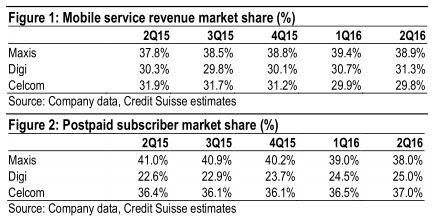
Both Digi and Axiata reported results that disappointed street estimates, while Maxis' results were in line. On a YoY basis, Celcom was the worst performer (1H16 mobile service revenue -11.9%) as the 'loss' of VAS revenue persisted in 2Q16. This resulted in Celcom losing 2.1% market share in 1H16 vs 1H15. While Digi's 1H16 mobile service revenue dipped 1.9% YoY, it gained 1.0% market share, while Maxis gained 1.1%, even when its 1H16 mobile service revenue dipped 1.6% YoY. The Big 3 retained their flat YoY service revenue guidance, but we think it will be tough to play catch up in 2H16, given that pricing on data remains weak, despite robust data consumption.

At the EBITDA level, the Big 3's normalised EBITDA was 6.8% lower YoY in 1H16. Maxis had the lowest decline (-1.4% YoY), while Digi and Celcom's dipped 7.9% YoY and 13.3% YoY, respectively.

telco revenue

..but share prices of Maxis and Digi did relatively well recently
The mobile operators continue to underperform the FBMKLCI index on a YTD basis but post-Brexit and BNM's rate cut, Maxis and Digi's share prices have outperformed the index (Axiata did not perform as well, given the poor earnings outlook). The share prices were also supported by the strong take-up rate for the Shariah Savings Fund, launched by the EPF recently (analyst Tan Ting Min wrote about this on 22 Aug 2016).

malaysia mobile operator

Back to reality: TM and UMobile need to gain market share
When we met UMobile recently, we understood from management that its intention to list is very well alive and that its shareholders will continue to fund the business. In order to do that, management will focus on: (1) subscriber market share, (2) revenue market share (targeting to double it to 10-12% from 5-6% currently), and (3) profitability (still EBITDA –ve in 2015). To achieve these targets, management intends to launch a nationwide marketing campaign next year, after the company has received 900MHz/1800MHz spectrum.

Given that TM will also need to gain market share during the same period, there is a risk of further earnings downgrade in 2017 as revenue and EBITDA growth prospects remain muted as the market is saturated. As a reminder, since Jan-16, the market has already lowered Axiata, Digi and Maxis' 2017E EPS forecasts by 16.7%, 13.0% and 11.4%, respectively. Also, even if the spectrum fees for the 900MHz/1800MHz bands are not exorbitant, there is still more
downside risk to the street's earnings estimates, and hence, dividends, as competition will intensify and there will still be payments for the 700MHz/2300MHz/2600MHz bands.

Maintain UNDERWEIGHT
In conclusion, we retain our UNDERWEIGHT stance on the sector and Axiata remains our top pick. While it will take time for Celcom's new management to turn the business around, it is the only company without a Malaysia-only mandate. Hence, we expect upside to the share price if XL Axiata and other op-companies deliver the results.

Other potential negatives include: (1) aggressive competition by other MVNOs, especially TuneTalk and Yes 4G, (2) a weaker MYR, and (3) high-than-expected spectrum fees.

source: Credit Suisse – 30/08/2016

Mar 7, 2016

Malaysia Strategy: 4Q15 results By Sector

malaysia highlighted company


Mixed 4Q15 results
■ 4Q15 results were mixed, with 40% of companies under our coverage reporting results below our expectations.
■ Revision ratio for 4Q15 was at 0.63x, largely similar to the previous quarter.
■ Our 2016 market EPS growth forecast falls to 5.7% (7.5% previously), but we expect stronger earnings growth in 2017.
■ KLCI target cut from 1,900 to 1,800pts, based on 3-year average P/E. 


malaysia 4Q15 result by sector


Mixed 4Q15 results
The 4Q15 corporate results were mixed, with 40% of the companies under our coverage reporting results below our expectations (29% in 3Q15). However, the percentage of companies that beat our expectations rose from 18% in 3Q15 to 25% in 4Q15. Plantation and aviation sectors positively surprised while the rest disappointed. Revision ratio was unchanged qoq at 0.63x.


4Q15 EPS growth

4Q15 EPS rose both on yoy and qoq basis, which is a positive sign. On a qoq basis, 4Q15 EPS rose 9.7% mainly due to the strong earnings recovery in the plantation and aviation sectors.


EPS growth outlook this year

We have lowered our CY16 market EPS growth forecast to 5.7% from 7.5% previously. Consensus growth is at 7.5%. However, for CY17, our 8.4% market EPS growth is much higher than consensus. While this reflects our more conservative market EPS recovery expectation in 2016, we believe EPS growth momentum should continue into 2017. 


KLCI target falls to 1,800

Our previous KLCI target was based on a 5% premium to the three-year moving average of 15.5x P/E. In view of our uninspiring 2016 market EPS growth outlook, we are removing the 5% premium. Our new KLCI target is based on the 3-year average of 15.5x P/E and our end-2016 KLCI target falls from 1,900 to 1,800pts. Our preferred sectors are still banking, construction and select smaller-cap stocks.

source: CIMB Research - 02/03/2106

Nov 12, 2015

3QCY15 Earnings Preview: Expect Largely Positive Growth Among Major Sectors

,

KLCI: 1,685.70 points 2015 Year-end Target: 1,650 points

Aggregate adjusted earnings of FBM KLCI stocks may increase +15.6%qoq and +8.5%yoy. For the quarter ended September 2015, the aggregate reported earnings of FBM KLCI current constituents is estimated at RM13.66b. Against the combined RM13.56b earnings reported in preceding quarter, it is expected to record a rather minute sequential growth of +0.8%qoq in 3QCY15. Conversely, adjusted for extraordinary and non-recurring items, the on-quarter growth may be glaringly higher at +15.6%qoq. On the other hand, the on-year reported growth figure in 3QCY15 is estimated to fall by -1.7%yoy. However, the adjusted on-year growth number might be starkly better at +8.5%yoy, which is also a reversal to the -11.4%yoy adjusted growth performance of the prior quarter.

3QCY15 aggregate reported earnings is estimated at RM13.66b (adjusted at RM15.15b)malaysia aggregate earning

Largely positive adjusted performance among major sectors. We are expecting largely positive earnings performance among the FBM KLCI’s Big 5 sectors, i.e. Banking, Oil & Gas, Utility, Telecommunication and Plantation. Of the Big 5 sectors, only Banking and Plantation are expected to report slight negative on-year earnings growth. On the other hand, we expect positive on-quarter growth for all Big 5 sectors excepting Plantation.

FBM KLCI: Quarterly adjusted earnings (RM million) and growth estimates

FBM KLCI Quarterly adjusted earnings table

•  Banking. We continue to expect earnings growth of banks in 3QCY15 on year-on-year basis to remain unexciting. This is due to: i) persistent NIM pressure contributed by strong competition for deposits impacting banks’ funding cost and lower asset yield, (ii) market volatility affecting treasury and IB income resulting in challenges to grow NOII and iii) higher credit charge-off from lower recoveries as well as due to higher provisions due to asset quality weakness of international operations and upticks in impairment of domestic loans. Our top picks are Hong Leong Bank (BUY, TP: RM14.60) for its defensive qualities and Maybank (BUY, TP: RM9.80) for its diversified earnings and attractive dividend yield.
•  Oil & Gas. On aggregate, the O&G constituent stocks registered mostly positive year-over-year earnings growth in 3QCY15. Petronas Chemicals’ 3QCY15 earnings grew the most both year-on-year and quarter-on-quarter due to the exceptionally good plant utilisation rate of 88%. Petronas Dagangan also posted commendable year-on- year results as average selling prices were higher despite a decline in volume sold. However, Petronas Gas experienced a reversal in profit growth as its gas cost rose significantly subsequent to the government’s decision of periodically removing subsidies on gas price. As for the only O&G service provider listed on Bursa, SapuraKencana staged a commendable growth (excluding the provisions done for its oilfields) as its drilling division experience a high vessel utilisation rate of 98.5%. Despite the challenging environment, we are still
bullish on SapuraKencana (BUY, TP: RM2.89) due to its diversified business offerings and strong orderbook of RM23b.
•  Utility. This sequential earnings growth of Utility sector was boosted by the recognition of the Imbalance Cost Pass Through (ICPT) for the 17-month period from January 2014 to May 2015 in the preceding quarter amounting to RM1.82b by Tenaga Nasional Berhad (TNB). Furthermore, its on-year earnings growth was contributed by the easing trend in fuel costs due to the decline in coal and gas prices, and couple with a more favourable generation mix. We maintain our BUY call on TNB with a TP of RM15.60.
•  Telecommunication. The expected weak on-year growth performance among telecommunication players is reflective of the maturing and competitive industry landscape whereby ARPU is continually under pressure but expenditures, particularly for marketing and branding, remain high. This is further exacerbated by the introduction of goods and services tax in April 2015 which impacted the purchasing power of subscribers. We do not think the competitive and fast-evolving operating environment landscape will improve anytime soon. Widening the
coverage area of 4G LTE as well as introducing more value added services would be some of the key determinant factors to remain competitive in the industry. Under the prevailing competitive landscape, we favour Digi (BUY, TP: RM7.04).
•  Plantation. 3QCY15 average CPO price of RM2058/MT was lower by 7%yoy hence is likely to result in lower earnings for plantation companies. However, as for KLK, we are expecting earnings improvement on-year as its Manufacturing division is expected to recover from the losses in same quarter last year. Recall that in 3QCY14 (or 4QFY14 for KLK), the oleochemical sub-division in the Manufacturing division suffered a write down of RM13m due to a sharp drop in its selling products. Meanwhile, PPB may register modest earnings growth of 3%yoy as we expect its earnings recovery trend to continue. We also expect Wilmar’s Oilseeds and Grains division margin to stay positive in 3QCY15 with higher volume processed. Quarter-on-quarter, 3QCY15 average CPO price of RM2058/MT was lower by 6%. Accordingly, we expect plantation companies to register lower sequential earnings. However, we expect PPB earnings to be much stronger on-quarter as Wilmar’s Sugar Milling division usually turned into profit seasonally in 3Q due to the processing of harvested sugar cane in Australia.

Beginning of the end to the earning drought? Stabilization, or even more so improvement, in earnings sentiment could be an enduring catalyst for the equity market going forward. While corporate earnings had incessantly disappoint both ours and consensus expectations during the 6 previous result seasons, nevertheless, the ongoing reporting season has up until now seems pointing towards the beginning of the end to the prolonged drought in earnings growth. Recall that in 2QCY15 there were 9 underperformers against only 4 outperformers among FBM KLCI constituents (1QCY15: 10 underperformers, 0 outperformer). While it may be too early to tell, the ongoing 3QCY15 season might fare comparatively better as there is only 1 underperformer against 3 outperformers thus far out of 11 results released.

Reiterate FBM KLCI year-end 2016 target at 1,800 points. We restate our assertion that empirical observations between earnings and price are conclusive with regard to the nature of their secular direct relationship. This is despite the ever present ‘noises’ from short-term price volatility which is influenced by market sentiment and other situational issues. Against the backdrop of recovering earnings growth next year, we reiterate our 2016 FBM KLCI target at 1,800 points. The baseline target equates to PER16 of 16.0x and +0.5SD. Also, we maintain our year-end 2015 FBM KLCI baseline target of 1,650 points (with upper and lower range of 1,700 and 1,600 points respectively) which equates to PER16 of 14.7x and -0.3SD.

FBM KLCI: Earnings versus Price
FBM KLCI Earnings versus Price

source: MIDF Research 09/11/2015