Showing posts with label Stock Picks Financial Analysis. Show all posts

Aug 7, 2018

Malaysia - Alpha Picks: Convalescing

Still convalescing from the heavy selldown post GE, our July alpha picks delivered a simple average gain of 11.3%, above FBMKLCI’s +5.5%, as the new government’s decisions on mega projects have been less disruptive than feared, thus allowing construction stocks to partially recover. We add MRCB to August’s picks, along with Bumi Armada, CMS, Gabungan AQRS, Inari and VS Industry.

WHAT’S NEW
Review of July’s picks. Recovering from a hefty selldown from GE 14’s aftermath, 5 out of 7 of our alpha picks were above the FBMKLCI’s mom return of 5.5%. The portfolio garnered a simple average of +11.3% for the same period, mainly led by CMS’ stellar performance (+34.0% mom) which we attribute to rising optimism in 25%-owned OM Sarawak’s significant recovery of higher production and improved ASP. This was followed by Gabungan AQRS’ +16.7% returns due to multiple factors (fee warrants, potentially generous dividends from 2019-23, and optimism in securing mega projects).
SPLASH deal to provide ripples in other government deals. Last Friday, the government significantly upped its offer to buy water treatment plant SPLASH to RM2.55b, more than 10x higher than the offer made in 2013. While still at a substantial discount of 20-25% to Splash’s book value, the deal is positive (and expected to be accepted SPLASH’s owners) as it resolves a long-term gridlock for this cash flow- strapped entity. We reckon SPLASH’s resolution will lead to expectations that: a) the long overdue water pipeline replacement projects (benefitting pipe manufacturers like Engtex), and b) resolution to more government dependent deals, such as the sale of MRCB’s EDL highway.

ACTION
Adding MRCB to August’s portfolio, in anticipation of major monetisation and de- gearing exercises via its stake sale in Bukit Jalil Development (KL Sports City) and a potential sale of EDL. Companies dropped from the list include Serba Dinamik, given its stellar share price run-up (+20.0% mom).
August’s alpha picks are Bumi Armada, Cahya Mata Sarawak, Gabungan AQRS, Inari, MRCB, and VS Industry.

ANALYSTS’ TOP ALPHA* PICKSanalyst top alpha picks

Bumi Armada (Kong Ho Meng)
• 2018 is set to be a turnaround year for the group, with earnings set to ramp up from 2Q18 on Olombendo's final acceptance in May 18. The improved frequency of monthly offloadings of Kraken to three tankers since Jan 18 is positive as it shows Kraken’s production improvement is real and ongoing. This will sustain Kraken's earnings qoq into 2Q18, while Kraken's final acceptance is also on track by mid-18 (which will lift 2H earnings further). We also see the possibility of a TGT1 extension by Aug 18.

Share Price Catalyst
• Conclusion of final acceptance of Kraken and Olombendo by 1H18.
• Recovery of OMS utilisation and rates.

Cahya Mata Sarawak (Abdul Hadi Manaf)
• We expect 2Q18 earnings to be substantially strong, driven by a major turnaround at OMS. Currently, CMS is trading at only 10.9x forward PE. We expect the PE to trend closer to pre-GE level as the recent sell-down was unwarranted. • 2Q18 earnings are expected to neatly beat consensus forecast, led by a significant earnings jump at 25%-owned OM Sarawak.

Share Price Catalyst
• Significant jump in OM Sarawak’s 2Q18 earnings.
• Commencement of another mega project MPA (phosphate manufacturing) in 3Q18, which leverages on cheap electricity from Bakun dam.

Gabungan AQRS (Kader Farhan)
• Provides both earnings growth and generous dividend payments (2019-23), backed by sales momentum of property development division . The company is targeting to secure> RM2b of contract works for ECRL as well as Sabah portion of the Pan Borneo Highway Sabah (PBHS), which would also lift the group’s precast manufacturing division. The government has allowed the ECRL project to proceed, while a final decision on PBHS is still pending (although construction works are already ongoing for some stretches).

Share Price Catalyst
• Clinching contract parcels for ECRL.
• Remaining stretches of PBHS receiving the government’s nod to go ahead.
• Strong take-up for E’Island, a RM491m GDV medium-end priced but high quality condo project in Puchong, Selangor.

Inari Amertron (Yeoh Bit Kun)
• Earnings are expected to improve hoh in 2HFY19 on: a) RF production ramp-up to support its US end-customer’s smartphone launch in September, and b) contribution from data centre chip testing job and fibre-optics chip fabrication and wafer certification jobs.
• Outlook remains positive on: a) new jobs from OSRAM (related to facial recognition and health sensor products for smart devices and mini LED for billboard applications), b) in- house job (foundry bank-end process for fibre optics products) transfer from Broadcom to be completed at end-18, c) consolidation of operations to improve operational efficiency, and d) potential new business for its Batu Kawan plant which is currently under construction.

Share Price Catalyst
• Benefitting from weakening ringgit.
• Confirmation on new contracts.

MRCB (Kader Farhan)
• The development of KL City Project in Bukit Jalil (GDV: RM20.7b) and the potential sales of EDL are expected to strengthen its overall earnings and balance sheet. In addition, its strong orderbook backlog of RM6.2b would potentially provide earnings visibility for its construction arm for the next 3-4 years coupled with its modest reliance on federal government's related project. Also, Putrajaya's nod to proceed with LRT3 project shall be viewed positively as MRCB will continue to become the project delivery partner (PDP), although the proposed "fixed contract" mechanism may potentially contribute lower earnings vs pre-agreed PDP fees.

Share Price Catalyst
• Sales completion of Bukit Jalil and other transport oriented development projects.
• Disposal of EDL.
• Various asset monetisation programmes.

VS Industry (Fong Kah Yan)
• We believe that the worst is over after the weak 3QFY18 results. We expect margins to recover on better operating leverage on commencement of new models for its key customers in 2H18 and 1H19. VSI is currently focusing on filling up capacities at its two new plants which came on-stream in mid-18. Hence, potential large contract wins to fill- up capacities at the plants will lift sentiments further.

Share Price Catalyst
• Large contract wins from key customers or/and new customers.
• Favourable forex movement.

Valuationcompany valuation

source: UOBKayHian – 06/08/2018

May 16, 2018

Malaysia’s Council of Eminent Persons

,

Reassurance From New Council Of Eminent Persons


The Council of Eminent Persons held a briefing for investors, shedding some light on certain broad-based measures. However, details of fiscal reforms will only be announced in the first 100 days, aimed at raising disposable income. Architects of the PH manifesto reiterate that the government must deliver: a) institutional reforms – including reducing/eliminating corruption, b) strong check and balance, and c) economic reforms – ensuring that money is in the hands of Malaysian households.

council of elders
WHAT’S NEW
Council of Eminent Persons instilling confidence. The newly-formed Council of Eminent Persons (Council) held a briefing for investors yesterday with Tun Daim Xainuddin and Tan Sri Zeti Aziz as speakers. Raising disposable income is a key focus. The Council has been actively meeting various representatives from the investment community (eg GLC funds) and regulators (eg MoF, Securities Commission, Chamber of Commerce) and reassured that Malaysia’s fundamentals and financial system remain strong, and that any near-term weakness in the fiscal position due to the abolishment of GST will be short-term in nature as swift execution of its economic and institutional reforms should lead to stronger market confidence and consequently improved fiscal position and ringgit strength.

Key highlights of the briefing. a) Measures of the comprehensive fiscal reform to be released within the first 100 days will be orderly in nature. b) Comprehensive review of the tax regime with emphasis on GST. c) Emphasis on reducing public wastage (eg government’s procurement cost) and curbing of corrupt practices as well as scrapping certain mega projects will help to partly plug the revenue gap from the abolishment of GST. d) A task force to be set up to recover 1MDB monies and a separate group comprising the MACC, Attorney General and police to investigate scandals and charge relevant people involved in the 1MDB scandal. e) The government’s role will gradually decline and the private sector playing a more prominent role, hence reducing the “crowding out effect” on private investments. f) More transparent open bidding and assessment of mega infrastructure projects. g) Made recommendation to the government that no politicians be involved in GLCs. h) The government will also honour its debt obligations with regard to toll concessionaires.

Setting up a committee on institutional reforms. The Council has also announced the formation of a committee on institutional reforms, crucial in ensuring a strong follow through and execution of the positive economic reforms

ACTION
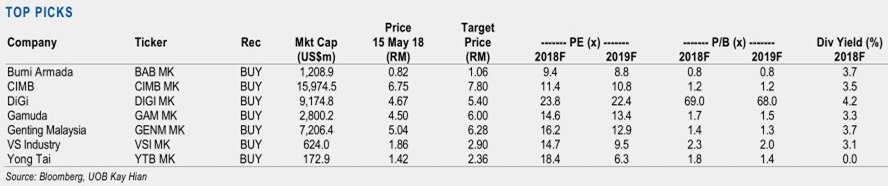
Strategy. While we still favour defensive stocks and apolitical growth stocks, upside for most of these stocks is limited by the recent days’ run-up (eg BAT). We also advocate buying oversold construction stocks. We maintain our end-18 FBMKLCI target of 1,830. Stocks which offer good upside visibility include defensive large caps DiGi, Magnum, the Genting group, E&E stocks Globetronics and VS Industry. growth stocks Bumi Armada and Yong Tai. Some recent run-down stocks appeal, eg CIMB, Gamuda and Gabungan AQRS.

stock picks post GE14

ESSENTIAL
The Pakatan Harapan manifesto… We had recently attended a forum titled “Keeping The
Promise of Reform” organised by the Jeffrey Cheah Institute on Southeast Asia. Key panelists Wan Saiful and Liew Chin Tong were some of the many architects behind the Pakatan Harapan manifesto.
...focuses on the well being of the rakyat and a strong check and balance system. Key takeaways are: a) strong emphasis on the need for institutional reform, and b) economic reforms. The key message on economic reforms is that ordinary Malaysians must benefit from economic growth and it is the role of the government to make sure that the money is in the hands of the households (focusing on productivity and multiplier effect of the economy). It is also the job of the current government to reduce/ eliminate corruption and create a strong check and balance system (including limiting the Prime Minister’s term of office and ensure a strong and viable opposition party by providing funding for them).

source: UOBKayHian – 16/05/2018

Apr 17, 2018

Malaysia’s Stocks Immune To a Trade War

,

Many stocks have been caught up in the sell-off, which include domestic-centric stocks that should not have been directly impacted by a limited trade spat. We highlight four such stocks: Genting Malaysia, Mynews Holdings, Petron Malaysia and WCT.

US And China Trade Tariffs
There is no trade war yet….
… but the rhetoric on both the US and Chinese sides had been escalating until President Xi Jinping’s conciliatory speech at the Boao Forum for Asia on Apr 10, where he pledged “new phase of opening up” for China’s markets.

So far, the proposed measures over the past three months have been as follows:
● Jan 22: President Donald Trump approved a 30% tariff on solar panels and a 20% tariff on washing machines which affect China and South Korea the most.
 ● Feb 16: The United States Department of Commerce presented several options to combat China’s trade practices, including tariffs of 24% on all steel imports (and 7.7%
on aluminium) which are widely seen as aimed particularly at China, the world’s largest steel maker.
 ● Mar 7: Europe pushed back as the EU officials threatened to place tariffs on American-made goods if the US would impose such tariffs on imported steel and aluminium.
●  Mar 8: The US approved 25% tariffs on steel and 10% on aluminium; Mexico and Canada were granted initial exemptions.
 ● Mar 22: President Trump announced a plan to impose annual tariffs on USD50bn worth of goods from China.
 ● Mar 22: China made its own threat stating it would impose tariffs on USD3bn worth of American-made goods. The move was in response to the earlier decision in March by the Trump administration to impose steel and aluminium tariffs; this announcement came shortly after President Trump had disclosed his USD50bn tariff plan.
 ● Mar 22: The US decided to grant more exemptions on its steel and aluminium tariffs by offering temporary exemptions to the EU, South Korea and others.
 ● Apr 2: China imposed tariffs of up to 25% on 128 American-made products (including wine, pork, pipes, etc.) in response to the US-imposed tariffs on steel and aluminium. This action would mainly affect the US farm land and the rust belt communities, which have been politically important for President Trump.
 ● Apr 3: The US targeted electronics and it formally proposed tariffs on USD50bn worth of Chinese-made products, including flat-screen TVs, medical devices, aircraft parts and batteries.
 ● Apr 4: China countered with tariffs on soybeans, cars and chemicals and proposed USD50bn in tariffs on additional American-made products.
 ● Apr 5: President Trump doubled down and said he was considering imposing additional tariffs on USD100bn worth of goods, in response to China's retaliation.
 ● Apr 10: While speaking at the Boao Forum, President Xi promised a new round of opening up in China. Chinese officials were quick to emphasise that these measures were always a part of China’s economic plans and were not in response to the US threats.

There is an important reason to take this war of words seriously. For many years, before he became President, Mr Trump has been critical about the global trade system being unfair to the US economy and it is one area where he has been consistent. President Trump has always felt the US was not getting a fair deal from its trading partners. China has been singled out as the most “unfair” partner of all as it ran the largest trade surplus with the US at USD375bn in 2017 2 .

Regardless, there is a reason to predict this won’t go much beyond words. After all there are no winners in this war and this fact alone makes one believe that an actual trade war may not actually materialise. The issue really comes down to what each party hopes to achieve, what tools they have at their disposal, and ultimately what each is willing to compromise.

To be fair, the US complaints do have a certain amount of legitimacy, since China is not as open to imports from the US as the US is to imports from China. Just a couple of examples: the tariff China applies on US-made cars is 25% while the US imposes only a 2.5% tariff on Chinese-made autos; also, there is a forced transfer on technology that is imposed by China on the US firms, when setting up of joint ventures, as there are limits on ownership.

However, making the trade deficit the poster child is probably the way to go. The US current account deficit largely reflects a shortfall of domestic savings to investments, and unless the savings or investments rates change, the trade deficit will largely remain unchanged. If the US imposes tariffs on China, it may reduce its deficit with China but it may also in turn increase its deficit with some other countries. Therefore its overall deficit (as a percentage of GDP) would probably remain unchanged. There may also be a secondary effect - if the overall cost of imports rises, it would in turn affect the exchange rate, and hence the magnitude of the deficit.

In any case, if the US does go down the tariff route, the main impact on ASEAN is likely to
be through the value chains, and most likely be felt on electronics and electrical appliances sectors which we have addressed before.

The Chinese tariffs are likely to have a different effect as there isn’t really a value chain that uses intermediate inputs from the ASEAN which ends in the US. In any case, the Chinese tariffs are directed at agricultural products and more likely, the main result will be through a rise in the price of certain global commodities.

If matters get bad, there could be a rise in risk aversion, and markets may move to a “risk
off” setting. The Fed, despite its claims that its actions will not be affected by tariffs, is likely to take the rise in policy rates to a flatter trajectory than what we are predicting. At the very least, the Fed may take on a "wait and see" approach and which case the safe haven ssets, such as the US Treasuries and currencies such as the JPY, are likely to rally.
If things get really worse, it is possible that China may use other methods which it has at its disposal and the US doesn’t. For instance, there is already speculation that China may hoose to devalue the CNY 3 . There also is a possibility that China could threaten to sell or
even outright sell part of their holdings of US Treasuries, even at a loss.

Ultimately, how this pans out will depend on what both sides really want. In our view, if the US wants a greater access to the Chinese markets, it is likely to obtain it. If, on the other hand, this is actually a battle for the future of technology, such as robotics, electric cars, aerospace, or for cutting edge investments in artificial intelligence, the US may find a China that is not malleable. If restrictions are applied on Chinese acquisitions, then we may really be seeing a trade war.

For now, our expectations are that the war of words may continue with occasional threats
and occasional concessions and the markets may dance in step. This matter should probably stop at a certain stage, before it actually becomes a war of action. In such a scenario, various opportunities present themselves, both in defensive stocks or in stocks
where there has already been an over-correction.

Malaysia

Of the stocks under our coverage, about 71% have seen an YTD decline, battered not only by negative sentiment arising from the US-China trade tantrums but also by caution over the impending 14 th General Election (GE14). Both the US and China are important trading partners for Malaysia, while the electrical & electronic (E&E) segment is a major component of Malaysia’s exports. Naturally, technology sector names have been the worst affected as investors price in the potential negatives. However, many other stocks have been caught up in the sell-off and include domestic-centric stocks that should not be directly impacted by a limited trade spat. We highlight four such stocks.

malaysia stocks trade war

Genting Malaysia (GENM MK, BUY, TP: MYR5.94)
We like Genting Malaysia’s earnings resiliency from its casino operations, which in our view could prove to be one of the best defensive picks amidst current US-China trade friction. While the share price has underperformed the benchmark FBM KLCI YTD, we advise investors to accumulate on weakness as we continue to see the opening of its 20 th Century Fox outdoor theme park by end-2018 to be a major visitation re-rating catalyst. This could then spur patronage to its hilltop casinos and hence improve profitability in the long run.

To briefly recap, the new facilities under its Genting Integrated Tourism Plan (GITP) would continue to open progressively over the next 6-12 months. Management reaffirmed that the 20 th Century Fox outdoor theme park is set to open later this year, while the Skytropolis indoor theme park would commence operations in 2H18. Out of the MYR10.4bn capex allocation, the group has thus far spent MYR6bn to date, with the remaining likely to be utilised by 2018/2019. Overall, 4Q17 visitor arrivals to the hilltop resorts grew to 6.7m (+34% YoY) and we expect further upside come 2H18 upon opening of new facilities.

Mynews Holdings (MNHB MK, BUY, TP: MYR2.03)
Mynews’ prospects are largely driven by the domestic market, and we think it is unlikely to be affected by the trade friction. This is given that all of its Mynews convenience store outlets are based in Malaysia and all of the products are sourced locally. We like Mynews for its attractive value proposition of exciting earnings growth, ambitious multi-pronged expansion plans, as well as the leadership of an entrepreneurial and driven management team. Its earnings growth would be underpinned by the outlet expansion as well as the rising demand for convenient ready-to-eat (RTE) food, which would be captured by its food manufacturing plant.

Petron Malaysia (PETRONM MK, BUY, TP: MYR10.70)
The group’s products are mainly sold in Malaysia (largely gasoline and diesel products) and pricing is pegged to weekly changes in Means of Platts Singapore (MOPS), therefore a trade war would not affect the group’s business directly. We like this stock because we think it has been oversold on overblown concerns of weaker refining margins. After factoring in significantly weaker (27% lower) gross margin/bbl in 2018, the implied FY18F P/E is at 8.9x, still an attractive level for a mid-cap. In addition, its petroleum product sales are also strong, with high single-digit growth (market growth was close to nil) achieved in FY17 due to effective marketing strategies. Petron Malaysia focuses on refining and distribution of petroleum products, concentrating largely on the Malaysian domestic market.

WCT (WCTHG MK, BUY, TP: MYR2.18):
A potential breakdown in trade negotiations between the US and China, in our view, would have little bearing on the Malaysian construction industry. High impact public transportation projects that have been announced or awarded such as the Mass Rapid Transit Line 3 MRT3), KL-Singapore high speed rail (HSR) and the East Coast Rail Link (ECRL) sit atop the Malaysian government’s list of priorities due to their social and economic benefits. In addition, funding for the projects has either been identified (HSR, ECRL) or is in the final stages of being determined (MRT3).

The Malaysian stretch for the HSR project is to be funded by the Malaysian Government, while the ECRL project would be funded by a soft loan provided by China Exim Bank. The MRT3 project, meanwhile, is expected to be funded by a consortium of local and international banks. A potential breakdown in trade negotiations between the US and China is unlikely to significantly shift China’s commitments on its One Belt One Road (OBOR) initiatives – and ECRL’s soft loan from China Exim Bank – in our view.

For exposure to the construction sector, we recommend that investors buy WCT. The company was one of only a handful of contractors that secured work packages for both the MRT2 and Light Rail Transit Line 3 (LRT3) – where It was the only company to secure three packages totalling MYR1.7bn. Hence, we see WCT as a good proxy to the bulge in government spending for domestic public transportation projects. The stock is underappreciated, in our view, having retraced 25% YTD. This is despite the company sitting on an outstanding orderbook of MYR5.6bn, which is a record for the company, and underpins our forecasted 3-year earnings CAGR of 21%.

source: RHB Research Institute – 13/04/2018

Mar 6, 2018

Alpha Picks: Opportunities Arise

Our February alpha picks delivered a simple average return of 2.3%, outperforming the FBMKLCI’s -0.7%. The recent market pullback provides good opportunities to accumulate our March alpha picks (unchanged from February’s picks) of Ann Joo, Bumi Armada, GAQRS, Serba Dinamik, VS Industry and Yong Tai. We continue to expect emerging re-rating catalysts for these stocks by 2Q18.

WHAT’S NEW
Review of February picks. Four out of our six alpha picks outperformed the market in February, delivering a simple average return of 2.3% (FBMKLCI: -0.7%). Leading the list was Ann Joo which saw a 7.4% increase on a low base from last month’s fall and amid recovering steel bar prices (+4.4% mom), followed by Serba Dinamik’s 6.4% increase and Yong Tai’s at 3.3%.
Opportunities amid cautious investment sentiment. While market sentiment has turned cautious earlier than expected, we still expect selective small-mid caps to outperform the market. Key events to watch out for in the coming weeks or months are the dissolution of parliament for the general election (expected in March), the award of mega projects (ECRL, MRT3 and the PDP portion of HSR), and Yong Tai’s opening of the acclaimed Impression Melaka theatre.
Overreaction to US’ proposed tariff on steel imports. Malaysian steel stocks took a beating last Friday, as investors reacted to the US’ intention of slapping a 25% tariff on steel imports (targeted at China imports). Specific concerns are: a) China redirecting surplus production to Asia; and b) an expanded US-China trade war could extend the US dollar’s weakness. Nevertheless, we assess that ASPs in Asia would continue to be firm, and markets will eventually react positively to an expected qoq rise in 1Q18’s profit margins.

ACTION
Retaining our March picks of Ann Joo, Bumi Armada, Gabungan AQRS, Serba Dinamik, VS Industry and Yong Tai (see re-rating catalysts in the table below). While not in the list, other notable BUY rated stocks like Genting Bhd and Inari could offer attractive upside.

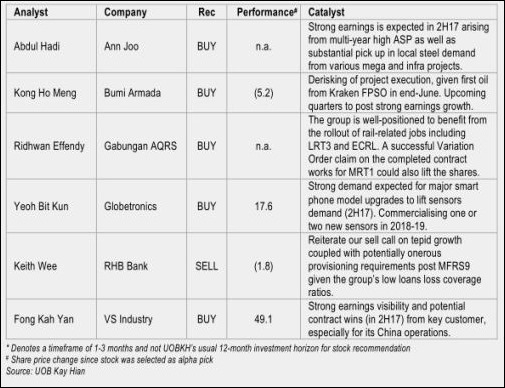
ANALYSTS’ TOP ALPHA PICKSanalyst top picks 2018

Ann Joo Resources (Abdul Hadi Manaf)
• Following the strong yoy earnings growth in 2017, we believe that the positive momentum will continue with local steel bar prices having increased further to RM2,750/MT (+4.4% mom) in Jan 18, mainly due to the sharper-than-expected production cuts in China during the heating season.
• The potential US tariff implementation on imported steel may not necessarily be bad news for Malaysian steel producers. This is because Turkey, which is a key steel exporter across Asia, may incur higher scrap metal costs should steel production in the US rise. To note, currently Turkey sources most of its metal scrap from the US.

Share Price Catalyst
• Significant improvement in local steel demand.
• Local steel ASP rising to a multi-year high.

Bumi Armada (Kong Ho Meng)
• 2018 is set to be a turnaround year for the group, with earnings set to pick up from 1Q18 when Bumi Armada potentially receives almost full charter rate recognition from both Olombendo and Kraken (Kraken by 2Q18). The offloadings of Kraken onto three tankers since Jan 18 is positive as it shows Kraken’s production improvement is real and ongoing, which should translate into higher rate recognition in 1Q18. We also see the possibility of a TGT1 extension.

Share Price Catalyst
• Conclusion of final acceptance of Kraken and Olombendo by 1H18.
• Recovery of OMS utilisation and rates.

Gabungan AQRS (Ridhwan Effendy)
• The group is armed with an outstanding orderbook of RM2.8b. For 1H18, expect contract wins of high-profile construction jobs in the East Coast Rail Line (ECRL) and the Sabah portion of the Pan Borneo Highway (PBH). The group’s precast manufacturing division is also poised to benefit from the Sabah PBH as it owns one of the largest precast manufacturing facilities in Sabah together with the Sabah Economic Development Corporation.

Share Price Catalyst
• Positive contract newsflow by 1H18.
• Concrete premix production associate securing a substantial contract.

Serba Dinamik (Kong Ho Meng)
• Earnings growth to trump expectations on yearly new contract wins (RM2.8b target to bring total 2018 orderbook to RM7.2b - close to management's guidance of RM7.5b) and high renewal rate (>80%) of its existing orderbook. We expect Serba to announce more contracts as it embarks on its asset ownership strategies. Our earnings forecasts are above consensus’.

Share Price Catalyst
• Higher-than-expected new orderbook wins and renewals.
• Lower-than-expected costs and quicker profit breakeven achievement from JV income (Muaro Jambi)

VS Industry (Fong Kah Yan)
• In addition to several assembly lines for box-build products that have commenced production since Nov 16, VS Industry began building another three assembly lines in 4Q17. Key catalysts in the medium term will be the gradual capacity fill-up at its new plant (which can accommodate up to 12 assembly lines) upon completion in mid-18 on the back of potential contracts from new customers.

Share Price Catalyst
• Securing new contracts from existing or new customers.
• Securing new contracts for its China operations via 43.5%-owned VS International Group.

Yong Tai (Ridhwan Effendy)
• Tourism-related developer Yong Tai targets to open the critically-acclaimed Impression Series theatre in Melaka by end-April, the first outside of China, which could generate annual net profits of >RM60m in a full year of operations. To further tap on the success of the Impression Melaka show, Yong Tai will develop the land around the theatre. It will also undertake niche developments to diversify earnings growth drivers. We are also optimistic on the viewership for the theatre’s shows, given the success it had in China.

Share Price Catalyst
• Positive construction progress of the Impression Melaka theatre which is set to open in
May 18.

VALUATIONstocks valuation

source: UOBKayHian – 06/03/2018

Jan 10, 2018

Alpha Stock Picks 2018: A Smashing Start

Although our alpha picks’ return of +1.86% trailed the FBMKLCI’s +4.9% in Dec 17 amid hefty year-end window dressing, these picks have started the year with smashing month-to-date returns of 0.7-11.8%. Some have technically broken out. Good domestic liquidity and positive newsflow for these stocks should ensure continuing positive momentum. We maintain our alpha picks for January, namely Ann Joo, Bumi Armada, Gabungan AQRS, Globetronics, Serba Dinamik, VS Industry, and Yong Tai.

WHAT’S NEW
 Review of Dec 17’s picks. Only one alpha pick outperformed the market’s incomparable +4.9% return in Dec 17. Some index stocks were pushed up amid the year-end window dressing. Coming in at +5.2%, Ann Joo’s respectable performance rose in tandem with the mom (+8.1%) rise in the average steel bar price (Dec 17: RM2,633/MT).
 Key event catalysts during 1Q18 are: a) strong reporting season and hopefully good capital management for the steel (benefitting Ann Joo) and E&E (VS Industry, Globetronics) sectors, b) indicative of strong demand for Yong Tai’s Impression performance, c) mega construction contract awards (Gabungan AQRS), and d) Bumi Armada hoping to receive full charter rate for FPSO Kraken.

ACTION
 Our January picks continue to be Ann Joo, Bumi Armada, Gabungan AQRS,
Globetronics, Serba Dinamik, VS Industry, and Yong Tai.

ANALYSTS’ TOP ALPHA* PICKSalpha stock picks 2018

Ann Joo Resources (Abdul Hadi Manaf)
A blowout 4Q17 reporting season is expected, benefitting from steel bar prices that are at ulti-year high. In Dec 17, local steel bar price increased further to RM2,633/MT (+8.1% qoq) mainly due to sharper-than-expected production cut in China during heating season.

Share Price Catalyst
 4Q17 earnings could potentially a blowout quarter.
 Significant improvement in local steel demand.
 Rise of local steel ASP to a multi-year high.

Bumi Armada (Kong Ho Meng)
2017 is set to be a turnaround year for the group, with earnings set to pick up by 1Q18 when Bumi Armada potentially receives almost the full charter rate recognition from both Olombendo and Kraken. The offloadings of Kraken onto three tankers (at implied 15k bpd) is positive as it shows Kraken production is ongoing. It needs a higher frequency of offloads to imply a real recovery in production. We also see the possibility of TGT1 extension.

Share Price Catalyst

 Conclusion of final acceptance of Kraken and Olombendo by early-18.
 Recovery of OMS utilisation and rates.

Gabungan AQRS (Ridhwan Effendy)
The group is armed with an outstanding orderbook of RM2.8b. In 1H18, we are expecting positive newsflow from potential contract wins that the group is gunning for. This includes high-profile construction jobs in the likes of East Coast Rail Line (ECRL) and the Sabah portion of the Pan Borneo Highway (PBH). Also, the group’s precast manufacturing division is poised to benefit from the Sabah PBH, as it owns one of the largest precast manufacturing facilities in Sabah together with the Sabah Economic Development Corporation.

Share Price Catalyst
 Positive contract newsflow by 1H18.
 Concrete premix production associate securing a substantial contract

Globetronics (Yeoh Bit Kun)
We remain upbeat on Globetronics’ prospects and expect 4Q17 to be the strongest quarter for the year, driven by higher production volume for sensor products as well as margin improvement due to better economies of scale. There could be earnings upside to our 2018/19 forecasts due to: a) commercialisation of developing products (particularly 3D imaging sensors), and b) strong demand for gesture sensors (due to end-client’s bundling strategy).

Share Price Catalyst
 Commercialising one or two new sensors in 2018-19, which are currently under co- development with the client, could significantly lift our earnings forecasts.

Serba Dinamik (Kong Ho Meng)
Earnings growth to trump expectations due to a combination of yearly new contract wins (RM2b) and the high renewal rate (>80%) of its existing orderbook. We expect Serba to announce more contracts as it embarks on its asset ownership strategies. Our earnings forecasts are above consensus.

Share Price Catalyst
 Higher-than-expected new orderbook wins.
 Lower-than-expected costs, especially on tax (Serba is expected to pay IRB tax claims from 3Q17 to early-19).

VS Industry (Fong Kah Yan)
In addition to several assembly lines for box-build products that have commenced production since Nov 16, VS Industry began building three additional assembly lines in 4Q17. Key catalyst in the medium term will be the gradual capacity fill-up at its new plant (which can accommodate up to 12 assembly lines) upon completion in mid-18 on the back of potential contracts from new customers.

Share Price Catalyst
 Securing new contracts from existing or new customers.
 Securing new contracts for its China ops via 43.5%-owned VS International Group (VSIG).

Yong Tai (Ridhwan Effendy)
Tourism-related developer Yong Tai will soon open the critically-acclaimed Impression Series theatre in Melaka, the first outside China, which could generate net profit of >RM60m p.a. in a full year of operations. To further tap on the success of the Impression Melaka show, Yong Tai will develop the land around the theatre. It will also undertake niche developments to diversify earnings growth drivers. We are also optimistic on the viewership of the performance, given the success that it has had in China.

Share Price Catalyst
 Positive construction progress of the Impression Melaka theatre.

souce: UOBKayHian – 08/01/2018

Dec 18, 2017

Outlook for Malaysian oil and gas names improves

,

■ Petronas recently released its activity outlook report, and the guidance for the volume of work in 2018-19F appears to have increased from the previous March guidance.
■ This will be positive for Malaysian O&G companies, which have likely passed the  nadir of their earnings in either 2016 or 2017F.
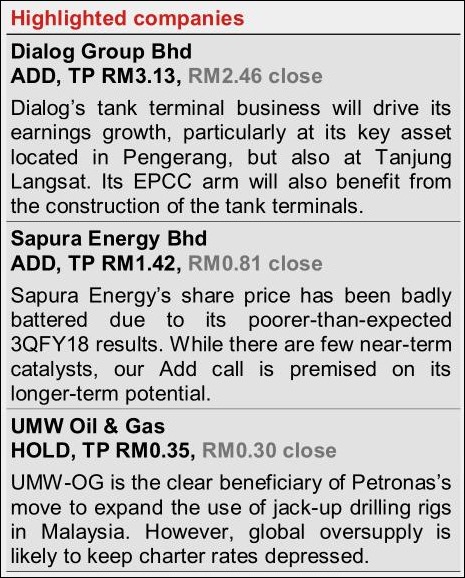
■ We recently added Dialog and Yinson to our coverage, our two top sector picks, both with Add calls, and also recently upgraded UMW-OG to a Hold, and SAPE to an Add.
■ Hence, we upgrade our sector rating to an Overweight, from Neutral previously.

IEA does not expect oil prices to hold at current levels…
Although the spot price of Brent crude breached the US$60/bbl barrier on the upside in late-October, fundamental demand-supply projections by the International Energy Agency suggest that prices should weaken sequentially in 1H18F, before rising again in 2H18F.
This is because supply growth from non-OPEC sources in 2018F is more than sufficient to meet global demand growth projections, resulting in a ‘call on OPEC crude’ that is actually below OPEC’s current production levels.

…but Petronas’s capex budget may be based on a higher oil price
In the “Petronas Activity Outlook 2018-2020” report that was recently issued in December 2017, Petronas said that it expected oil prices to hover around US$50-60/bbl. This view is unchanged from Petronas’s view in March 2017, when it issued the inaugural version of the same report. In any case, Petronas appears to have turned more positive on its projected capex for 2018F and beyond, suggesting that it may have based its budgeted capex on an oil price assumption that is higher than its US$45/bbl assumption for 2017F.

Outlook for jack-up (JU) drilling rigs has improved…
Between March and December 2017, Petronas raised its expected demand for JU rigs. This is positive for UMW-OG and Perisai, as we expect domestic demand to cover most, if not all, of their available JU rigs. However, we expect Petronas to continue to demand attractive rates, and perhaps pressure these local players to reduce their price offers.

…but does not translate into demand for tender drilling rigs (TDR)
In contrast, demand for TDRs has not moved much, and Petronas is forecasting that it will only need 2-3 TDRs for 2018-19F. SAPE has 15 TDRs in total. Petronas’s modest demand for TDRs means that SAPE will need to focus on securing foreign jobs to achieve our forward utilisation assumption of 50%. We expect the SAPE group to register core net losses for the next three forecast years, as drilling losses more than offset expected profits from the engineering and construction (E&C) and energy arms.

Outlook for E&C work has improved
The prospects for local fabricators appear to have improved, with Petronas now guiding for more wellhead platform fabrication jobs, even though central processing platform fabrication volumes are likely to remain low. More heavylift installation and offshore pipelay installation work is also expected. The outlook for hookup and commissioning and maintenance work has also improved, with more man-hours expected. The better prospects in E&C should benefit SAPE and other Malaysian players.

malaysia oil gas outlook  
Number of Offshore Support Vessels (OSV) required has increased
In December, Petronas indicated that it will require more AHTS and fast crew boats in  2018-19F than previously guided in March. This is positive for local OSV players like Bumi Armada and ICON Offshore.

Top sector picks: Dialog (TP: RM3.13) and Yinson (TP: RM4.88)
Our top sector picks are Dialog and Yinson, as they both have a good track record in
execution and their business models have relatively low risk profiles. We also have an
Add on SAPE as the sharp sell-off has exposed longer-term value, and an Add on BAB
as its Kraken and Olombendo FPSOs are heading towards final acceptance.

source: CIMB Research – 15/12//2017

Dec 5, 2017

Winners And Losers Of A Stronger Ringgit Malaysia

,

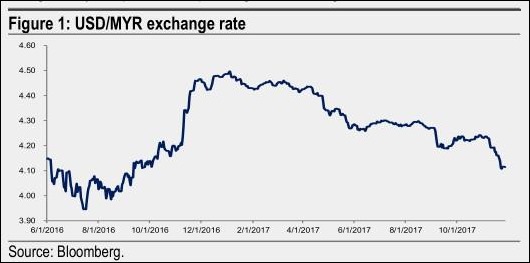
● CS' FX strategy team has raised USDMYR forecast to 4.0 in three months and 3.80 in 12 months (from 4.10 and 4.0 previously). RM has appreciated 8% vs the USD YTD and is currently at the strongest level so far this year.
● In our view, companies most materially affected would be (1)  those with mismatch in USD-denominated revenue and cost, (2)  companies with majority of profits derived from offshore operations, (3) companies with sizeable foreign currency denominated debt.
● Key beneficiaries of a stronger RM in our view are TNB, Air Asia  and Astro. Meanwhile, our screen seems to suggest that there is a longer list of potential losers which include: telecommunication companies (Axiata, TM, TimeDotCom), rubber, petrochemical  companies, Inari, IHH and plantation companies.
● The adverse impact of a stronger RM on corporate earnings could be among the key factors suppressing street's corporate earnings estimates (Malaysia is the only market in Asia with no 2017E EPS growth) despite the improving economic growth outlook.

RMUSD exchange rate

We take a look at the possible winners and losers of a stronger RM vs USD.

Winners
● TNB - Tenaga’s USD-denominated debt as at 31 August 2017 amounted to RM6 bn (16% of total borrowings). Our rough estimates show that a 10% strengthening in MYR against USD should have an approximate 12% impact on earnings, all else constant. Nevertheless, we understand that TNB has hedged at least 50% of its foreign currency exposure up to 12 months, hence possibly reducing the quantum of the earnings impact.
● Air Asia - AirAsia has a significant portion of borrowings which is USD-denominated (RM8.4 bn or 86%) as at 30 June 2017. Bulk of its operating cost (fuel and maintenance) is also dominated in USD; although AirAsia has hedged 50% of its USD opex up to December 2017, the unhedged portion coupled with the expiry of these hedges beyond 2017 would have a positive impact on earnings. Assuming foreign-denominated cost is not hedged, a 5% appreciation in RM would lead to a 5% boost in net profit.
● Astro - The stronger RM is positive for Astro as its content cost is denominated in USD. We estimate that Astro’s bottom line in FY19E and FY20E will improve by 3.1% and 6.5%, respectively should the ringgit improve to RM3.80 (less impact in FY19E as Astro has hedged 80% of its annual USD exposure today).

Losers
● MY telcos - mobile: The stronger RM is unlikely to impact MY  telco’s IDD business anymore, given that they are now pricing their services using the ‘cost plus’ method to avoid the pitfalls in 2016 (it became a loss-making business). That said, the scenario will likely be negative for Axiata, given that ~70% of its FY18E EBITDA is denominated in foreign currency. We estimate that if  RM trades at RM3.80 vs USD, it would have an approximate
5%/15% impact on Axiata’s FY18E EBITDA/net profit, all else equal; earnings exposure to foreign business will be partially offset by some modest interest savings due to Axiata's sizeable USD debt. However, management could take pre-emptive steps (such as re-negotiate interconnect fees, reduce traffic in impacted areas) to mitigate the impact.
● MY telcos – fixed line: Within the fixed line space, both TM and Time Dotcom’s submarine cable business will be impacted if RM strengthens, given that the contracts are generally priced in USD. However, the impact is modest, based on our estimates given that if RM trades at RM3.80 vs USD, only 7-10% of TM and Time’s revenue will be impacted (~3% of EBITDA).
● Rubber companies such as Top Glove and Karex whose revenue is USD-denominated would be negatively impacted by a stronger MYR. We estimate a 10% strengthening in MYR will have a 25% earnings impact on Karex, ceteris paribus. Meanwhile, the same sensitivity on Top Glove will impact earnings by approximately 7%. Nevertheless, we highlight that the exporters typically adjust selling prices to reflect any adverse forex movements, albeit with a slight 1-2 months’ time lag.
● Petrochemical companies tend to lose out in a strong RM environment as revenue is denominated in USD (product prices linked to international prices). Though majority of its costs are in USD (feedstock, energy costs, etc), some portions of its costs are in RM. We estimate 8% and 12% negative earnings impact for every 5% appreciation in RM for PCHEM and LCT, respectively.
● Plantation – Plantation companies tend to be adversely affected as stronger RM would lead to lower revenues (palm oil traded in USD) while the bulk of cost is denominated in RM.
● Inari: A stronger RM is negative for Inari as it bills its client in USD.  We estimate that there could be 8-10% downside to our net profit estimates in FY19-20E assuming USD-RM at RM3.80.
● IHH - IHH Healthcare’s growth would be negatively impacted in the scenario of stronger RM as it generates >80% of total core revenues outside of Malaysia. If the currency appreciated to RM3.80 relative to USD in FY18, revenue and EBITDA could be affected by ~4%-5%, everything else equal.

source: Credit Suisse – 26/11/2017

Nov 6, 2017

Malaysia Budget 2018 and Stock Picks

,

Infra pump priming and consumer spending led 2018E GDP growth of 5.2%
Prime Minister Najib set an upbeat tone in 2018 Budget by forecasting 5.2% to 5.8% GDP growth. The pillars of 2018 GDP growth YoY are construction (+7.6%), services (+5.8%) and manufacturing (+5.3%). The winners of this budget are contractors (IJM & GAM), airport operator (MAHB), tourism (GENM) and consumer-centric proxies, such as Astro, telco and convenient stores (Bison). Outlook for tobacco players, such as ROTH, is gloomy as the government merely estimated excise duty collection growth of 4.5%.

Infra pump priming continues and Malaysia aims to create 3.3mn new jobs
The re-affirmation of key projects (MRT 3, High-Speed Rail, East Coast Railway, LRT) worth MYR175bn coupled with MYR6.5bn for rural development and plans to upgrade and expand airports, plus many to-be confirmed projects should keep Malaysia contractors busy until 2026. Besides the major players, we expect smaller contractors, such as Sunway Con, George Kent, AZRB, Muhibbah and WCT, to benefit too. The sector will support job creation.

Personal income tax cut to spur consumer discretionary spending
The 2ppt reduction in taxable income ranges from MYR20-70k should lift disposable income by MYR300-1000 against household income of MYR43k. Further, the infra projects’ estimated multiplier effect on CY18-20E on M2 by a magnitude of MYR2.5-5bn per year (+4-6% YoY) might have a positive impact on consumer discretionary proxies. The influx of foreign labour should benefit telco players in the prepaid market and convenient stores such as Bison.

Malaysia Budget 2018 Allocation:budget 2018 stock picks

Visit Malaysia 2020, to host APEC, WCIT and CHOGM
Budget forecasts a modest 28mn tourist arrivals (+5% vs. 2016) in 2018. But in 2020 Malaysia will host many world events, such as World Congress of IT and Commonwealth Heads of Government Meeting. The inbound and domestic tourism is expected to be buoyant and benefit Malaysia Airport (MAHB). The gaming tax collection is projected to rise by MYR340mn. Assuming no change to the gaming tax, this implies a 11% YoY growth or MYR2bn gross gaming revenue growth – a good read-through on Genting Malaysia (GENM).

Top picks: GENM, IJM, KLK and MAHB; remove ROTH

While illicit cigarette clamp-down has been successful (down 4ppt to 56%), the irrational price war initiated by PMI and JTI Malaysia should erode margins, leading us to remove ROTH from our top picks. The recent sell-down of GENM, in our view, has fully priced in the risk of Mashpee write-off, gaming tax hike and bad 3Q17 results. We remain highly convinced about its growth prospects. KL Kepong’s (KLK) valuable 6600 acre land bank (40km outside of KL City) should benefit from the growing economic development in the capital. Note the entire land bank is worth its current market cap. We also like MAHB for its
exposure to inbound and domestic traffic growth prospects. Moreover, it offers an option to Malaysia’s e-commerce logistics play via Alibaba’s investment.

Last, we add IJM into our top picks. IJM represents a strong proxy to China-led growth, using increased investment from China as a part of its strategic One Belt, One Road initiative and being one of the first beneficiaries of China’s ambitions in Malaysia via the Kuantan Port. The port now stands to be China’s gateway for raw and finished materials from Malaysia.

Valuation and risks
Genting Malaysia
Our target price for Genting Malaysia is based on sum-of-the-parts (SOTP) valuation comprising 20x 2017 P/E for domestic, UK and US gaming operations. While the pegged target is higher than the historical trend, we believe that it is justifiable given the growth is sustainable for next three years. We have pegged 1x historical PB to investment properties. Downside risks include the possibility of further controversial M&A activity, intensifying regional competition and regulatory tightening in operating and potential markets and lower-than-expected return for new investments in the US. Given the lack of clarity in operational data, profit forecast accuracy is thus at risk.

IJM Corporation
We value IJM based on SOTP. We value the construction segment based on a 16x FY19E P/E, in line with the industry average multiple, but also taking into account the growing order book. Meanwhile, we value the industry segment based on a 15x P/E, given the strengthening demand for building materials due to the increased infrastructure investment. We value the property development business using a DCF of its land bank, using a WACC of 6.8%, a 15% development margin and the infrastructure space using a WACC of 6.8%. IJM plantation and Scomi are valued based on market value. A 10% Holdco discount is assumed to arrive at our one-year forward TP. Key risks for IJM include: 1) Execution risk on its construction order book. We assume an average annual replenishment of c. S$3bn. An inability to secure or replenish its order book would be a downside risk. 2) A downturn in the property sector would have a significant impact on valuations, which accounts for 22% of our RNAV estimates. 3) A slower-than-expected ramp-up and expansion of Kuantan port; we forecast the port to reach capacity by 2020, and for the second phase to be completed by 2024. Delays in completion or ramp-up would affect valuations.

KL Kepong
Our target price is based on a sum-of-the-parts valuation, as its earnings are derived from palm oil-based profit and the property development segment. On the earnings front, we apply a 17E 15x P/E (mean valuation). On the property front, we apply a 65% discount to RNAV given the long gestation on unlocking value from the large land bank. Key industry downside risks: a major downturn in CPO or soybean prices; Indonesia's government halts the biodiesel policy; environmental issues that might lead to a revocation of land bank; and a ban of CPO usage in certain countries. Key company downside risks: earnings-dilutive acquisitions; worse-than-expected production; and labour shortages.

Malaysia Airports Holding
We use a two-stage DCF methodology to value MAHB. The first stage is for the initial 10 years based on our financial forecast, and the second stage is from the 11th year to end-of-concession-life at a FCF growth rate of 2% (below IATA long-term growth forecast of 3.5%). Our WACC is 9.1%, with 4.6% rfr, 5.1% CoD, 23% tax rate, 6.5% erp, 1.2x beta, and 65% target d/e ratio. At our TP, FY17E EV/EBITDA would be 12x, lower than 13x Asian average. Risks: 1) PSC revenue based on the 2009 OA does not materialize; and 2) translation losses if the MYR appreciates and depreciates against the EUR and TRY, respectively.

source: Deutsche Bank Markets Research – 27/10/2017

Oct 5, 2017

Kenanga’s 4Q17 Top Picks

Top Bursa Malaysia Stock Picks 4Q17

On stock picks, we are fairly selective this round. We even ran a Model Portfolio Optimisation to have a better idea on potential performance of our new list of Top Picks as per their respective historical performance.

To leverage on the rising trend of commodities, we pick ANNJOO (OP, TP: RM4.30) as one of our Top Picks. For Oil & Gas sector, we choose DIALOG (OP, TP: RM2.42). Apart from capitalising on better oil prices, the decision was also made based on the near completion of RAPID project. Moreover, the stock offers lower volatility as per our Model Portfolio Study.

kenanga 4q17 stock top picks
We also select BAUTO (OP, TP: RM2.40) as one of our Top Picks as we have upgraded the sector. Besides, with the new launching of car models, we could have already seen the worst in the latest quarterly numbers. We have also recently upgraded the rating and earnings estimates of TGUAN (OP, TP: RM5.67). The undemanding valuation of the stock provides ample room of upside from here. The same goes to AFFIN (OP, TP: RM3.00) as well. Despite the uncertainty over higher provision arising from the implementation of MFRS9, the undemanding valuations of 0.5x P/BV (vs. its 1-year historical average of 0.7x P/BV) could have already factored such concerns. We had also just initiated coverage on TAKAFUL (OP, TP: RM4.27) inspired by: (i) its undemanding valuation, which is trading at 2-year forward PER of 15x vs industry’s 17x as well as (ii) its reasonably good 2-year earnings CAGR of 14% (anchored by the growing demand for Takaful products, low penetration rates as well as government initiatives).

To leverage on potential Consumer consumption play ahead of Budget announcement, we have OLDTOWN (OP, TP: RM3.15), PARKSON (OP, TP: RM0.88) and SEM (OP, TP: RM1.70). Recall that PARKSON is also one of the Top Picks in the previous quarter based on the angle of “Deep-Value” play and potentially a “Turnaround” play as well.

PPB (OP, TP: RM18.90) is also selected as we have a more conservative view on crude palm oil (CPO) outlook. Our analyst reckon that CPO could trade at an average price of RM2,400/tonne for 2018 in contrast to the revised average CPO average of RM2,700 (from RM2,550 earlier) for 2017. The lower CPO should benefit downstream players like PPB.

As for exporters, despite the uncertainties over US interest rate direction, growth prospects for these players seem promising. Besides, our Modern Portfolio Study continues to suggest that continuous investment in export-oriented industries could achieve better return (of course with higher risk). Among the exporters, we choose HARTA (OP, TP: RM7.70), MPI (OP, TP: RM15.70) and PIE (OP, TP: RM2.87) as Top Picks for the quarter.

TENAGA (OP, TP: RM17.17), on the other hand, remains as our all-time favourite.

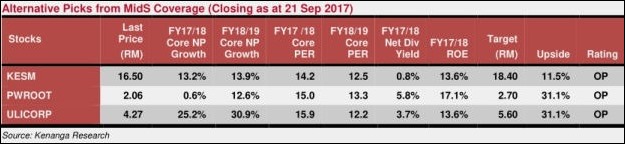
Alternative Picks from MidS Coverage

mids top picks

On a separate note, we also have three OUTPERFORM calls among MidS coverage that seem exciting and could also serve as alternatives to some of the Top Picks above. KESM (OP, TP: RM18.40) could be a replacement for MPI and PIE. PWROOT (OP, TP: RM2.70) can be an alternative investment to OLDTOWN. ULICORP (OP, TP: RM5.60); on the other hand, while it is not a direct comparable to ANNJOO as it is a downstream player, the company is likely to see stronger growth in coming quarters after the completion of its new plants. The company may not only benefit from capacity expansion, it will also benefit from the expansion of margin from its downstream business. We also believe its cost of production may not see much impact from hike in steel prices with its leading market position allowing pass-through of additional cost to end-clients.

source: Kenanga Research – 03/10/2017

Sep 6, 2017

Sept’s Alpha Stock Picks - Seizing Opportunities

A4 out of our 5 alpha picks outperformed the stagnant market in Aug 17 (FBMKLCI 0.7%), with three of our BUY picks delivering impressive monthly returns. Our portfolio of picks delivered a respectable and simple average of 3.4%. Our September picks: BUY Ann Joo, Bumi Armada, Gabungan AQRS, Globetronics and VS Industry. SELL RHB Bank. Ann Joo and AQRS are our new BUY additions, while Ekovest has been dropped.

WHAT’S NEW
Review of August picks. Four out of our four BUY alpha picks outperformed the market in August (see RHS), delivering a simple average of 4.5% (FBMKLCI 0.7%). Topping the list was VS Industry (7.7%), followed by Bumi Armada (5.0%), Globetronics (4.2%) and Ekovest (0.9%). However, our SELL-rated RHB Cap gained 1.0%, which reduced our overall average portfolio return to 3.4%.

Mega project plays to gain prominence in 4Q17. Our focus is particularly on: a) beneficiaries of the upcoming East Coast Rail Link (ECRL) and LRT3 contract awards, and b) steel producers that capitalise on twin benefits - sharp spike in steel prices with China’s ongoing Urban Blue Sky initiative and the expected local demand pick-up as mega projects ramp-up.

ACTION
Our Sep 17 picks. BUY Ann Joo, Bumi Armada, Gabungan AQRS, Globetronics, VS Industry, and SELL RHB Bank.

Gabungan AQRS and Ann Joo were added to our conviction BUY list, while Ekovest was dropped .
AQRS, a leading contender in clinching contract parcels of the ECRL and LRT3, is also hoping to recover significant variation order claims for its completed subcontract work for MRT1. Ann Joo is a standout in the steel sector, and could deliver impressive earnings in 2H17. Although we continue to like deep-value Ekovest, the stock did not react positively to recent events (separate officiations of KL River City and River of Life) and could lack near-term rerating catalysts.

ANALYSTS’ TOP ALPHA* PICKSanalyst top picks

ANN JOO RESOURCES
(Abdul Hadi Manaf)
Local steel bar prices have surged to a multi-year high of RM2,488/MT ytd (+14.2% mom). We believe that the local steel bar prices will sustain and potentially go higher when local steel demand picks up from various mega and infrastructure projects. Also note that China billets continue to trade at a premium and the price gap with local steel bars is widening.

Share Price Catalyst
 Significant improvement in local steel demand.
 Rise of local steel ASP to a multi-year high.
 Industry reform in China leading to a tight steel supply and sustained prices.

BUMI ARMADA
(Kong Ho Meng)
2017 is set to be a turnaround year for the group. 1H17 profit showed growth due to maiden earnings from Olombendo and Malta. New earnings from the remaining two floating projects (Kraken and Madura) will support a stronger 2H17 performance. We also see the possibility of a TGT1 extension.

Share Price Catalyst
 Full acceptance of FPSOs Olombendo and Kraken by end-17.  Recovery of OMS utilisation and rates.

GABUNGAN AQRS (Ridhwan Effendy)
Entry of new CEO, Datuk Azizan Jaafar, has brought in significant changes including: a)
a turnaround in the construction division with commendable margins; b) outstanding orderbook has been lifted to RM1.7b; and c) net gearing on track to hit 0.4x (from a high of 0.86x) by the year-end. The group’s all-time high construction orderbook of RM1.7b is expected to be boosted further in the near-term, driven by rail-related jobs, including LRT3 and ECRL. Also, a potential amicable settlement of the variation orders for MRT1 worth >RM100m could increase the likelihood of a bumper dividend.

Share Price Catalyst
 Further contract wins totalling >RM1b in the near term.
 Announcement of final settlement amount for MRT Line 1 with a potential of special
dividend.

GLOBETRONICS (Yeoh Bit Kun)
We are upbeat on Globetronics’ prospects, which is ramping up production of new sensor
products and planning for Phase 2 capacity expansion to meet end-clients’ demand. We expect significant improvement in earnings from 3Q17 onwards, given the full contribution from light sensors, which started mass production in June. We estimate strong net profit growth of 93% in 2018, but there could be earnings upside due to: a) commercialisation of developing products (particularly 3D imaging sensors), and b) strong demand for gesture sensors (due to end-client’s bundling strategy).

Share Price Catalyst
 Commercialising one or two new sensors in 2018-19, which are currently under co- development with the client, which could significantly lift our earnings forecasts.  Appreciation of US dollar against the ringgit.
RHB BANK (Keith Wee)
We maintain SELL and target price of RM4.65 (8.4% ROE, 0.82x 2017F P/B) given weak
growth trends (pre-provision operating profit growth 1.2% for 2Q17 and 1.7% for 1H17) and potential for relatively sharp increase in provisions post implementation of MFRS9 in 2018. The group has the lowest loans-loss coverage ratio inclusive of regulatory reserve in the industry at 81% (industry: 129%). This, coupled with RM1.8b in O&G loans under the watch list category (36% of total O&G loans portfolio and 1.2% of total loans base) does place upside risk to management’s rather benign net credit cost guidance of 25- 30bp for 2017.

Share Price Catalyst

 Potentially onerous provisioning requirements post MFRS9 given the group’s low loans
loss coverage ratios.
 O&G provisions and impairment may have yet to bottom out.

VS INDUSTRY
(Fong Kah Yan)
In addition to the three assembly lines for the vacuum cleaner box-build contract which
are slated to commence in FY17, we expect VS Industry to secure more contracts from
key customers in FY18 on increasing demand for existing products as well as new
product launches - notably in the beauty care segment.

Share Price Catalyst
 Securing new contracts from existing or new customers.
 Significant expansion plans by its China subsidiary.
 Sharp appreciation of the US dollar against the ringgit.

VALUATION
stocks valuation
source: UOB KayHian – 5th Sept 2017

Jul 13, 2017

BURSA MALAYSIA STOCKS SELECTION 3Q17

Top 10 Bigcap Stock Picks. Top 10 Small Midcap Stock Picks

Portfolio & stocks selection criteria. While we remain an advocate to portfolio exposures with a combination of stocks in the following order of preference (high to low): (i) inherent earnings quality, (ii) attractive valuation, and (iii) Growth at Reasonable Price (GARP) strategy Nonetheless, we are also mindful that the risks associated with these return expectations are also elevated due to the geopolitical risks which have a big influenced in market sentiment.

Changes to Top 10 list. We made four changes to our current list of Top 10 stock picks due to the following reasons:
- Kossan, Maybank and CIMB were removed due to their price run up during Q2 2017.
- Meanwhile, Gas Malaysia is relegated due its slower price appreciation todate and that there are other counters that an even bigger upside.

• In place of the above relegated stocks, we introduce SP Setia, AirAsia, Petronas Dagangan and Public Bank to our Top 10 list.   

Top 10 picks of bigcap stocks.

Below is a list of 10 bigcap stocks that fit the above mentioned criteria, which come from various sectors within our stock universe

- Malaysian Resources Corporation Berhad (BUY, TP: RM2.08). We are steadfast on the prospect on MRCB’s earnings estimates moving forward for FYE17 from (1) picking up of construction activities for Cyberjaya City Centre and Kwasa Damansara. (2) Strengthening of its balance sheet through rights issue that could possibly reduce its total debt of RM3.7bn to RM2.1bn (minimum scenario). (3) Potential rolling out of infrastructure projects under the National Development Planning (NDP) which reiterates the government commitment to boost rural and urban connectivity.

- Bermaz Auto Berhad (BUY, TP: RM2.50). Key catalyst: (1) Attractive dividend yield of 8.6% underpinned by net cash which accounts for 12% of market. (2) Value unlocking from the listing of BAuto Philippines (BAP). Current market cap attributes practically no value to BAuto’s stake in BAP relative to the 16x indicative IPO valuation and historical sector valuation of 12x (for Malaysian autos). (3) A more than doubling in associate earnings contribution to group (via 30%-owned Mazda Malaysia SB and 29%-owned Inokom) given a massive export market expansion. (4) Launch of the new CX5 and new CX9 which will drive a recovery in volumes and margins.

- Affin Holdings Berhad (BUY, TP: RM3.30). We continue to be encouraged by the Group’s future prospect and we believe that the Group is building its niche and this will ensure profitability based on (1) selective and cautious approach towards asset and loans growth, (2) believe that the Group will be in a good position to take advantage of any upswing in conditions with transformation instituted at Affin Bank and Affin Islamic Bank, and (3) income growth momentum will be maintained given the Group’s proactive management of its assets and liabilities.

- SP Setia Berhad (BUY, TP: RM4.13). We like SPSETIA due to: i) its plan to achieve FBMKLCI status is now fast track to 2018 (from 2020), ii) attractive price for the I&P deal, as we estimate that the market value of its landbank is RM6.15b (against its purchase price of RM3.65b) and iii) good dividend yield of 5.1%.

- AirAsia Berhad (BUY, TP: RM3.94). Airasia remains our top aviation sector predicated on: 1) stable demand growth with conservative Available Seat Kilometers (ASK) expansion of +10%; 2) monetisation of Asia Aviation Capital (AAC) that could potentially lead to special dividends; 3) further consolidation of all individual erating airline companies under the AirAsia Group could provide better clarity on combined performance of all these companies as opposed to Malaysia AirAsia.

- Tenaga Nasional Berhad (BUY, TP: RM16.80). Key catalysts: (1) Higher dividend catalyst on the back of an under-geared balance sheet and capital optimisation exercise (2) Overseas expansion provides scope for stronger growth in the mid-term (3) Strong earnings visibility post-ICPT implementation (4) Tenaga is a liquid proxy to the GDP growth outperformance and stronger trade, but share price has yet to move meaningfully relative to the broader market

- Telekom Malaysia Berhad (BUY, TP: RM7.77). We are comforted by the fact that UniFi’s customer base and ARPU continue to increase at a steady pace. Moving forward, we view that the progressive growth in TM’s broadband customer base would be further driven by the HSBB phase 2 and SUBB projects. On the mobility segment, the group’s target to launch Webe’s new prepaid plan in 2H17 remains intact. We opine that the ‘quad-play’ offering would further strengthen TM’s position in the telecommunication industry.

- Kuala Lumpur Kepong Berhad (BUY, TP: RM29.25). We opine that the company should fare better against other planters as for the Company earnings resiliency and its good FFB production growth estimated at 8% (highest among index-linked plantation stocks. It should be able to take advantage of the upcoming the pre-stocking activity ahead of Mid-Autumn
Festival should boost demand for palm oil from China from September onwards.

- Petronas Dagangan Berhad (BUY, TP: RM28.00). Key catalyst: (1) Petronas’ committed capital expenditure plan focusing on downstream oil and gas segment. (2) Opex to maintain at such levels in-line with the company’s Commercial Excellence initiatives. (3) the downstream utility and retail fuel segment is expected register commendable year-over-year earnings growth, offer above risk- free rate dividend yields and acceptable capital upside.

- Public Bank Berhad (BUY, TP: RM7.57). We continue to like the Group’s ability to achieve a robust loans growth whilst maintaining its asset quality. We also like the fact that the Group was able to manage its funding cost well which led to improvement in NIM. As a result, we expect that any NIM compression will continue to be manageable for the Group.

Top 10 Stock Picks

bursa malaysia top 10 picks

Top 10 Small Midcap Stock Picks

- Tune Protect Berhad (BUY, TP: RM2.18). Our positive is on the back of the Group’s various ongoing initiatives for product innovation, customer oriented and channel, and (2) Big tie up between Tune Protect and AirAsia is set to boost earnings moving forward.

- Dabochi Berhad (BUY, TP: RM3.02). Key Cataysts: (1) Indonesia and Myanmar to drive growth, It is securing new clients and orders, and closing in operational gaps and (2) Improving margins by cost past through mechanism to its major customers and operational cost reduction through better wastage control and operational efficiency.

- Amanah Raya REIT Berhad (BUY, TP: RM1.15). We recommend to company for (1) for its education property exposure (42% gross rental contributed from education properties) where rental reversion is typically resilient at 5-7%. (2) Prospect for asset management of ARREIT is positive following the entry of Kenedix Inc. as a substantial shareholder in December 2016. (3) Attractive dividend yield at 5.7%.

- Ta Ann Berhad (BUY, TP: RM4.30). We recommend the company due to (1) its plantation division earnings growth should remain strong due to high FFB volume growth expectation at 10%. (2) Its timber division is expected to remain profitable due to the support from high export logs price.
(3) It is a key laggard compared to its peers and trailed the KL Plantation Index despite its decent fundamentals.

- Hock Seng Lee Berhad (BUY, TP: RM2.00). Key catalysts: (1) Earnings make a comeback during the 2QFYE17-3QFYE17 as HSL would be able to recognize billings from Pan Borneo project. (2) HSL’s key competency in sewerage and wastewater engineering will anchor its future earnings prospect due to the strong need of efficient wastewater and sewerage connection in Sarawak. (3) HSL’s land banks are strategically located to be developed under the public housings such as Projek Perumahan Rakyat (PPR) and Projek Perumahan Penjawat Awam (PPA1M).

- Tasco Berhad (BUY, TP: RM2.91). We see positive impetus for Tasco in FY18 with acquisition of cold chain logistics assets. This would bode well for Tasco, as it is propelled from having nil cold chain assets to a market leader in the segment. Apart from that, a nascent recovery in international trade growth and an improving manufacturing sector would augur well for the company

- Muhibbah Engineering Berhad (BUY, TP: RM3.24). We reiterate our recommendation for the company due to the quality orderbook of RM1.86bn, or approximately 36 months (3.5x construction revenue cover) backed by recurring cash flow for its concession asset in Cambodia which has contributed 5-year median of 24.0% percent to its operating income.

- United U-Li Berhad (BUY, TP: RM4.88). Key catalysts: (1) Management targets to improve exports contribution from 20% to at least 30% in the next two years. (2) Modernising integrated facilities further with potential to expand operations at its new Nilai plant (3) As cables and electrical components are essential parts of a building, U-LI stands to benefit from the slew of infrastructure projects domestically and regionally.

- Tiong Nam Berhad (BUY, TP: RM2.08). We like Tiong Nam for its market leading position in the integrated logistics industry. Meanwhile, an IPO of its logistics assets into a REIT could provide immediate rerating catalyst for the stock, giving rise to the potential of special dividends.

- Spritzer Berhad (BUY, TP: RM2.83). We like Spritzer for its i) resilient earnings due to its defensive business model, ii) strong position as market leader in Malaysia’s bottled water industry with over 40% market share and iii) strong balance sheet with net cash position.

Top 10 Small Midcap Stock Picks

small cap top 10 picks

source: MIDFResearch - 11/07/2017

Jul 10, 2017

Malaysia Technology Stocks: Be Selective

,

We expect local tech companies, particularly those with high sales exposure to US smartphone brands, to deliver strong report cards from 2Q17 onwards. This could include upstream testing equipment players such as MMSV and Elsoft in 2Q17, followed by OSAT vendors from 2H17. However, given the sharp share price run-up within the sector, we advocate investors stick to companies with multi-year growth legs while the near-term good results provide trading opportunities in small-cap companies. Maintain OVERWEIGHT. Top pick: Globetronics.

malaysia technology stocks comparison

WHAT’S NEW
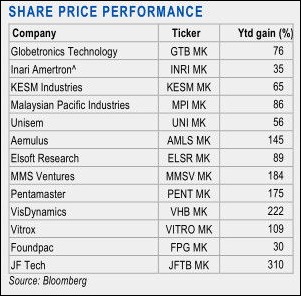
 ■ Local supply chain for US smartphone brand is poised to record strong earnings from 2Q17 onwards... The much anticipated launch of a new-generation smartphone by a US premium brand in 3Q17 is expected to have the relevant Malaysian testing equipment makers and outsourced semiconductor assembly and test (OSAT) providers reporting a strong set of results from 2Q17 onwards. Particularly, players that have high revenue exposure to this US end-client due to their sole supplier positions, such as upstream LED-related testing equipment makers MMS Ventures (MMSV MK, non-rated) and Elsoft (ELSR MK, non-rated), are expected to record superb results in 2Q17. OSAT vendor Globetronics (GTB MK, BUY) is on track to record strong earnings growth in 2H17 due to its sensor products. Inari, which has a dominant position on RF, is also expected to see a stronger 2H17.
 ■ ...despite rumours of a potential delay in the availability of the OLED screen model. Market consensus expects the US smartphone brand to stick to the traditional launch period of September for the roll-out of its three new flagship models (4.7-inch screen, 5.5-inch screen and 5.8-inch OLED screen) but some believe that there will be limited availability for the OLED model or a delay till mid-October/November (due to a delay in OLED production ramp-up). Despite the potential of a slight delay, we do not expect this to have an earnings impact on the relevant Malaysian vendors. Upstream players have delivered a majority of the orders in 2Q17 while certain OSAT players are loaded with more-than-expected orders and capacity expansion is on the way.

ACTION
 ■ Maintain OVERWEIGHT. Top pick: Gloebtronics. Local technology companies recorded a very nice share price run-up ytd (see overleaf side bar), with much of the rally fairly reflecting their outlooks. Among Malaysian vendors for the US smartphone brand, we see trading opportunities for the small-cap testing equipment makers on anticipation of the good upcoming quarterly results. Over the longer-term, we prefer OSAT companies which have more stable earnings with multi-year growth legs. Valuation-wise, OSAT companies are more attractive after the small-cap companies’ sharp run-up. Maintain OVERWEIGHT on the sector. Top picks: Globetronics.

malaysia techology stocks performance

ESSENTIALS
 ■ MMSV’s good results over the near term could provide trading opportunities. MMSV, which derives about 50% of its revenue from the smartphone segment, is expected to achieve 20-30% revenue growth in 2017, mainly on the back of its customised LED visual inspection solutions for its US end-client’s upcoming new smartphone models. Given that second quarter is seasonally stronger for the smartphone segment and the new testing equipment fetch higher selling prices, MMSV is poised to deliver one of its best quarters (if not the best) in 2Q17 (historical peak was in 2Q16 which reported RM20m revenue with RM5.7m net profit). Management shared that its existing margin is sustainable in 2017. This implies MMSV trades at 20-21x 2017F PE, on the assumption of 20-30% sales growth. While its valuation is not particularly attractive, its good results for the near-term could trigger trading opportunities.
 ■ MMSV: Expecting a weaker 2H17, dragged by non-smartphone segment. MMSV’s 2H17 could be weaker hoh due to the absence of orders from the more lucrative smartphone segment. MMSV’s other key areas of exposure are to the automotive, general lighting and semiconductor industries, which each made up 21%, 7% and 13% of its 2016 revenue respectively. While we are positive on MMSV’s automotive segment, but its revenue growth is lower than that of its smartphone segment due to a slower replacement cycle and a longer qualification period.
 ■ Globetronics: Stronger 2H17. Globetronics is ramping up its production volume on new light and gesture sensor products and is planning a Phase 2 capacity expansion to meet end-clients’ demand. We expect a strong net profit CAGR of 76% in 2016-19, and there could be potential earnings upside in 2018-19 due to: a) commercialisation of products under development (particularly 3D imaging sensor); and b) strong demand for gesture sensors (due to end-client’s bundling strategy). We expect Globetronics’ 2Q17 net profit to improve but it will still be an unexciting quarter as the light sensor’s mass production only started in June and loading volume is yet to normalise. We estimate 2Q17’s net profit to be in the range of RM7m-8m (1Q17’s RM6.0m, 2Q16’s RM5.5m) but will improve to
RM20m-25m per quarter in 3Q-4Q17.
 ■ Testing equipment makers’ earnings visibility is less predictable. Overall, we view that the earnings outlook for equipment players (with high concentration of a few key clients) is uncertain compared to OSAT’s. The outlook is highly dependent on whether the end-clients would need to replace existing equipment or simply need modifications on existing equipment to support new product launches. Testing equipment makers typically
have 3-4 months of order visibility.

source: UOBKayHian 10th July 2017

Jun 15, 2017

Malaysian Corporates With Exposure To The UK

Malaysia Market Strategy. YTLP, YTL and EWI are most exposed to the UK

● UK’s hung parliament increases political, Brexit and Sterling risks.
● Over three working days, the Sterling has weakened 2.6% against the MYR to RM5.3887. YTD, the Sterling has weakened 2.2%.
● According to CS Global Strategist Andrew Garthwaite in his report entitled “UK election: thoughts on a hung parliament”, Sterling is the critical driver (pharma, consumer staples performing the best when sterling weakens; retailing, banks and real estate the worst).
● There are just a handful of Malaysian companies with exposure to the UK, mostly via the property and utilities sector. YTL Power, YTL Corp and EcoWorld International profitability appear to be the most exposed to the UK.

Figure 1: Close correlation between UK property and Sterling
uk property sterling

The UK conundrum
Following UK’s hung parliament, CS Global Strategist Andrew Garthwaite in his report titled “UK election: thoughts on a hung parliament” highlighted the following conundrum.

Politics:
CS believes another election within a year is a strong possibility. The challenge is that those aged over 65 predominantly vote Conservative and many of Conservative’s policies (on social care, pensions and the winter fuel allowance) penalised them. The dilemma is that 66% of under 25s voted for Labour and 75% of under 25s votRemain in the EU referendum.ed

Brexit: Two-thirds of UKIP votes went to the Conservatives and there are around 40 committed Brexiteers in the Conservative ranks whose support the Prime Minister will rely on. This appears to limit the prospects for a softer Brexit.

Sterling
: The risk of a negotiating accident (i.e. a hard Brexit without a transitional deal) has risen, but still seems to be, on balance, unlikely. Sterling is 12% cheap on PPP against the dollar, and the current account deficit has more than halved. CS believes Sterling is unlikely to weaken further from current levels.

Macro
: CS economists continue to forecast 1.4% GDP growth (consensus 1.7%) versus 1.8% in 2016. Employment lead indicators are weakening and the savings ratio is at a 40-year low.

Small caps
are set to underperform large caps as PMIs roll over. An increased prospect of a Labour government is negative for small caps (rise in tax rates, more regulation, higher wages, higher rates).

Sectors
: Sterling is the critical driver (pharma, consumer staples performing the best when sterling weakens; retailing, banks and real estate the worst). CS stays underweight UK regulated utilities, London- and South East-exposed homebuilders (expensive, housing cycle rolling over and threat of increased tax), UK office REITs. CS remains overweight UK non-food retailing.

Figure 2: Malaysian corporates with exposure to the UKmalaysa exposure in UK

Malaysia’s corporate exposure to the UK
Over three working days, the Sterling has weakened 2.6% against the MYR to RM5.3887. YTD, the Sterling has weakened 2.2%. In Figure 1, we highlight Malaysian companies that have exposure to the UK, following the uncertainties and volatility over the hung parliament in the UK. There are just a handful of Malaysian companies with exposure to the UK, mostly via the property sector. YTL Power, YTL Corp and EcoWorld International profitability appear to be the most exposed to the UK. Over the past three days, YTL Power, YTL Corp and EWI’s share prices have remained resilient in light of the new risk, only falling by 1.3%, 0.0% and 2.9%, respectively.

source: Credit Suisse 14/06/2017